As promised here's the profile and interview I did for Tribeca Film...
If you're a regular moviegoer, you're familiar with his work. Even if you only get to the movies on special occasions for an Oscar hopeful like The King's Speech or an event film like the latest Harry Potter, you’ve heard it. Alexandre Desplat, the gifted 49-year-old French film composer is in demand. He scored five movies this year alone, with just as many on the way in 2011.
I had first scheduled an interview with Alexandre Desplat a full year ago, when he received his third nearly consecutive Oscar nomination for the whimsical score for the animated film Fantastic Mr. Fox. One year later, his voice finally materializes on the other line...
Wherein Desplat talks about his crazy workload, collaborating with Roman Polanski and composing around brilliant performances like Nicole Kidman (Birth) and Colin Firth (The King's Speech).
Earlier this month I met with Patricia Clarkson to discuss another fine year in one of the most pleasurable of modern character actor filmographies. Hers. I was waiting for the right opportunity to share it with you, and since Cairo Time is out on DVD, Academy voters are busy weighing the various Best Actress options, and today is Patty's 51st birthday, it was high time.
Through an unfortunate scheduling snafu I was less prepared when I met her than I am accustomed to being. I apologized with a wee warning that I'd be winging it. I bring this up because, as many of will remember, I have closely clocked her career. She came in at #2 in my 2005 countdown "Actresses of the Aughts" (yes we should revisit that list now that the decade has wrapped) and because I just want to share the unedited transcript. She was just so delightful to talk to. The punctuations and descriptions are my own of course to convey the flavor of the conversation. Happily, she's as vivacious and fun to interview as she is to watch onscreen.
Our conversation started by chatting about the NYC premiere of Cairo Time this past summer.
Nathaniel: Really enjoyed the movie. We didn't get a chance to talk afterwards at the banquet but you seemed very buoyant and happy that evening.
Patty: Yes. It was very nice night and it had been a long journey with the film. So... just up until then my mother and sister were in town. It was just a wonderful night to share it with my friends and my family [pause] ...and strangers.
[Laughter]
Nathaniel: Strangers like me sitting at the corner table. But it was wonderful to see you carry a whole movie for change.
Patty: It's a nice thing. It's rare. You know, I've been the female lead in a few things but it's rare to really kind of carry a film -- especially for me but it's even rare for women in general. We're always sharing top billing with somebody, you know what I mean? Or we're often the supporting people. It's beautiful that Ruba [Ruba Nadda the writer/director] wrote a film with a woman, almost 50, in the lead. That's how she wanted it. I'm very thankful to her for that always.
Patricia as Juliette.
Nathaniel: This character ["Juliette" in Cairo Time] has a really slow burn. I mean the character arc is very gradual.
Patty: Very! So gradual. It's really truly one of the most deceptively difficult parts I've ever played in my career. Not only because you're in every frame and you're shooting every day all day. But emotionally, oddly, it was... [her voice trails off thinking of the work]. It's a very, very quarter-inch by quarter-inch slow burn progression.
Nathaniel: In a situation like that do you have to have a lot of trust that the editing, for example, would bear you out since there's not that one scene? If you compare it to something like Far From Heaven where you can play a hairpin turn in the character that's just so devastating.
Patty: Right. Well that's also such a more forward character. This is... she [Ruba] wrote a very passive protagonist -- I found it very beautiful -- a very setback reluctant, for lack of a better world, woman at times. Antithetical to me and often to many characters I've played which are very forward and very gregarious and very present. This is a woman who is reserved, truly reserved. But I still think lovely and approachable in her own way.
Nathaniel: One thing I loved about the movie was the costume design.
Patty: Beautiful dresses, yes.
Nathaniel: They went along with the gradual arc so well. And the resolution of the movie -- those final scenes are just beautifully played.
Patty: Oh, thank you. It's the courage that Ruba had to really trust that those scenes would work, that they'd stay with the film and take this very, very subtle intimate --no bells and whistles! -- film and be around for the end and have the payoff. Most of the people I've seen have gotten it. They took the journey and were moved and transported. So...
Patricia & Alexander Siddig in the final scenes of Cairo Time
Nathaniel: Would you reteam with Alexander Siddig when you could let 'er rip more?
Patty: IN ANYTHING! There will be a sequel to Cairo Time. And it's just me and Alexander on a train. I've already written it. Ruba doesn't know about it but I've written it. And neither does Alexander.
[Much laughter]
Nathaniel: Speaking of actors who you don't get to get to see do leads enough...
Patty: He's such a beautiful stunning man. Ruba's next two projects are with Alexander and me. He's the lead in Ruba's next movie in Jordan, a beautiful story of a man whose daughter goes missing. And Ruba has another film for me that we'll shoot next January, a year from now. It's very exciting.
We're going to keep going with Ruba. [Laughter]
Whatever Patty Works... is magic
Nathaniel:Speaking of writer/directors... you've done two films with Woody Allen.
Patty: Yes, yes. I have high hopes for him; lovely unknown man.
Nathaniel: [laughter]
Patty: You know, it's an actor's dream to work with him and he doesn't disappoint. It was wonderful and I loved those parts that I got to play. Vicky Cristina Barcelona wasn't a large part but what was there was lovely and then Whatever Works was such a delicious divine part.
Nathaniel: You were the highlight.
Patty: Well... (giving credit away) Marietta! It's kind of a part I dreamed of playing, you know, just a big broad great southern lady.
Nathaniel: With Woody, you hear all sorts of contradictory things about him on the set. Some actors say he never speaks to them.
Patty: He's easy going but he's not chatty. This is why I really adore him. It's a very indulgent business; we are coddled and pampered so much. Woody just doesn't do that. It's all about the work. He doesn't care about your personal life. You show up. He wants you to be professional, know your lines, know what you're doing. Do your homework. He shows up and starts shooting at 9 AM, ready to go. He doesn't want drama. He doesn't want any of that. It's all about the work. I love that. I love that way of working.
Nathaniel: When you have to do a part that's heavily exposition as some supporting parts are, like in Shutter Island.
Patty: Yeah?
Nathaniel: How much of a challenge is that? It seems to me, from an outside perspective as I'm not an actor, that that would be both less rewarding and more difficult.
Patty: Well, Yes. At times it can be. But, remember, here I am. I'm working with Martin Scorsese who is divine and Leo... the two of them. They're a match made in heaven and they really make the best of an expositional circumstances. And it actually turned out to be, like, a real ride I had to take with that character and with Leo. And the cave. And my really ugly schmatte dress! And my wig!
[Much laughter]
You know it's like 'AAAAAHHH TROLL LADY!'
"People tell the world you're crazy and all your protests to the contrary just confirm what they're saying."
It was -- it ended up being surprisingly difficult in good ways. It did challenge me. Leo is a deeply committed and passionate actor. And so is Marty. Both of them are like powerhouses coming at you. There's nothing laid back and cool and simple and easy. It's like [makes whooshing noise]... it's a conducive environment to do good and hopefully great work. It is about about the work also. With great directors, it always is.
Patty: Beautiful year, yeah. I just saw her the other night at the Gothams.
Nathaniel: Her first couple movies, like High Art, were heavy and this one is really light and funny.
Patty: Although it's incredibly moving.
Nathaniel: Did you know she had that in her?
Patty: Yes, of course. She's just gifted. Great directors can just do anything. She has a marvelous sense of humor. She's very intelligent and I think she can -- because even in The Kids Are All Right there's pathos. I mean, there is. It's nuanced and hysterically funny but there is, you know, still depth of emotion that will always be in her work.
Nathaniel: You yourself have a real gift for comedy. One of the things I would love to see you do, if they even made them anymore, is a rapid fire screwball comedy.
Patty: OHMYGOD. I dream of that. You know, I dream of standing in a room in a smart sexy suit or sitting on a couch with my legs crossed chatting with George Clooney... rapid fire. Yes! [laughter]
Nathaniel: You get to do little hints of that but I would love a big screwball.
Patty: I do but I haven't done a kind of great balls-out real romantic comedy.
Tucci & Clarkson with Liza (!) at a Cairo Time event two weeks ago.
Nathaniel: You were a highlight of Easy A this year. Patty: We had so much fun, Stanley and I.
Nathaniel: You have great chemistry.
Patty: We do. Stanley and I have known each other for so long. We're very close in a really great way. We just have a cool friendship, we do. And we're able to modify it slightly and bring it on as, like, a married couple or whatever. We can take our friendship and mold it into what we need it to be whether that's for Blind Date or Easy A.
Nathaniel: I find in a lot of movies, a lot of times, the parent/child thing... you can't always see how the child would come from those parents.
Patty: Yes.
Nathaniel: And in that movie. You and Stanley were just -- it's like you genetically gifted all of your humor to her.
Patty: [Laughter]
Easy Mother and Grade A Daughter
Nathaniel: Because she had that same sort of lively...
Patty: Well, she is -- Emma Stone is sublime. You know, I hate this expression but she is a star. She is in the best sense. She's so beautiful and so multi-talented. She can do drama, comedy, action -- she's doing Spider-Man now. She's just really on her way and she should be. She should be. She's one of those new fabulous girls and she deserves to be.
Nathaniel: In terms of your public persona... do you get recognized a lot?
Patty: It depends on the city. If I'm in New York, oh god yes. If I'm in New Orleans oh god yes. In LA , yes. If I'm in Omaha, no. [Laughter]
Nathaniel: You've played such a wide range of roles. What do you think the perception of you is, generally?
Patty: I think it's shifted somewhat. [Reconsidering...] You know, I don't know.
Nathaniel: You don't think they come to you with any preconceived notions?
Patty: No. I think... Like in New York. It's like "oh, we love you. You're a New York actor." It's lovely. They claim me. 'Claim away, honey! As long as I keep working.'
I think people just think of me as, you know, just an actor. They're very flattering and complimentary most of the time. I'm trying to think -- I don't think anybody has ever come up to me and said "I don't like you" but there's always tomorrow.
[Laughter]
Nathaniel: One of my favorite parts of yours in Elegy.
Patty: Ohhhh, Isabel Coixet. Look at the extraordinary directors I've worked with! She's a stunning woman. She speaks five languages. She's a genius. She's one of the smartest people I've ever met and I have really smart friends. Like Rich Greenberg who is a genius. But she's one of a kind. I love that film. It's kind of taken on a different life, a new -- well, it doesn't have a cult following exactly but I have had a lot more people talking to me about it now than when it came out.
Nathaniel: It's one of your fullest characters I think. You were just giving us a lot of information about the character's life in a handful of scenes. Are there any other roles you wish would be rediscovered?
Patty: You know, I wish more people would see Blind Date. I know it's not for everybody but I love that film. I don't know if you've seen it?
Nathaniel: ... that one I haven't so I'm a little embarrassed that that's the one you name-check.[Laughter]
Patty: Noooo. You'll see it at some point. You can rent it. I hope people rediscover that. That's the one I hope for.
Nathaniel: I think the first time I saw you in a lead was [forgetting...] oh god...
Patty: Beautiful film. [Craig Lucas] is a sublime man. Deeply gifted, beautiful writer, and beautiful eye. He should be writing and directing. It's a wonderful film and that's been discovered in some ways. More people have seen it and say 'I love that movie... it's got that strange title...'
Nathaniel: Yeah, you had to prompt me too.
Patty: Yeah. But oh that white bikini. oh my god. [embarrassed high voice] WHOOOOO!!!
[laughter break]
Nathaniel: What's next for you Patty?
Patty: Not a white bikini !!!
[more laughter]
Nathaniel: Oh come on, you look pretty great in that dress in Cairo Time.
Patty: Beautiful dresses. What's next for me? I just did another movie with the Easy A director. This is a movie starring Mila Kunis and Justin Timberlake [Friends With Benefits]. And a small part in Lone Scherfig's new movie called One Daystarring Anne Hathaway and Jim Sturgess. I play Jim's dying mother. It's me doing British which is very intimidating in front of entire British cast and crew. I thought 'oh my god I am going to be dying by the end of this character.'
But it's good to be frightened at 50 and it's good that people keep upsetting the apple cart.
Nathaniel: It was a pleasure to talk to you. Thanks for bearing with me.
Patty: You didn't seem to be winging it.
Nathaniel: Well I've been watching since High Art.
Patty at the New Yorker Festival in October.
****
And with that we said our goodbyes.
Did you see Patty's triple this year? It's actually a quadruple as she had a role in Legendary but that one, alas, slipped by me. Which was your favorite of her recent roles? If you haven't seen Cairo Time, queue it up. But just make sure to turn off your phones. It's one of those movies that requires your full attention, all the better to appreciate Patty's careful modulation of that slow burn arc.
But then, you should always pay close attention to Patty's work. She rewards audiences again and again. * Leonardo DiCaprio Stanley Tucci
Part 2 Excerpts Alexandre Desplat is the busiest composer in film but he made time to talk a few weeks back. My profile will be up at Tribeca Film in January but for now I thought I'd share a few unused excerpts from our conversation whilst Academy voters are presumably scribbling down his name on their ballots for Best Original Score. But will they vote for The King's Speech or The Ghost Writer? [We discussed both movies ~ coming in Part 3.]
We'll know which score the voters preferred on January 25th unless, who knows, maybe they'll both be nominated? A double dipping wouldn't be unprecedented in that category and considering Desplat's workload it's bound to happen eventually.
Nathaniel: Is it difficult to take over something, a franchise, with ten years of pre-existing themes like Harry Potter? Did you have a lot less freedom?
Desplat: Well, John Williams, being one of the best composers of last 50 years, if not the last master of them all; I was more than happy to use some of his themes. The only theme that was meant to be reprised was "Hedwig's Theme" which has become kind of the Harry Potter main title. As I was starting work on the film I let my imagination go in many territories around this theme. When I was spotting the movie and started diving into the film it occurred to the director [David Yates], more even to me, that the theme did not have much left to do in this story because they're away from their school and the heroes are now grownups and this lovely world of fantasy is not their world anymore. So we used it two or three times early in the film almost to get rid of it, like they're getting rid of their childhood. It's part of their childhood to which they say goodbye. And the theme just vanishes for the same reasons.
On Process and Inspiration
Nathaniel: Is your process different for each film? How do you even begin the work?
Desplat: It differs for each film. The King's Speech I was shown the movie almost on its final cut. Some other films I get the script beforehand -- I got the The Ghost Writer script a year before. It's all very different which is good because you have to find different energies and different ways of getting inspiration. The main issue is how do you get excited, how do you get your cortex in movement? It could be from reading the script, it could be from seeing the images. Watching the images remains what I prefer because it has what the film has become. Reading the scripts it still belongs to literature so I am almost in favor of watching the first edit.
On Composing For International Cinema I was struggling with a question about Jacques Audiard's The Beat That My Heart Skipped (one of my favorite Desplat scores) and he saved me by predicting the question and jumping in.
Desplat discussing Benjamin Button with David Fincher
Desplat: You know the only difference is the language because the directors have the same obsessions. Even though they have their own grammar it's always the same vocabulary: closeup, wide shot, tracking shot, overhead shot, aerial shot, whatever. How many actors and the way you put them in the frame? So it's just a matter of communication for me to be able to translate in music what the director wants. Again, If the director has a strong point of view I enjoy the process that brings the music into his films. It's just a matter of spending time together, exchanging ideas.
I would always choose to work on a project that the story or the director resonates with me. With Ang Lee, Jacques Audiard or David Fincher, I found the same notion of exchange. These filmmakers have actually a huge cinephilia behind them. They know the history of cinema as well as I do. So we are in the same territory in a way.
Nathaniel: You're speaking the same langauge.
Desplat: Exactly.
On Oscar Ballots
You know I had to ask him about this.
Nathaniel: In addition to enjoying Oscar nominations, you've been a member of AMPAS for the past few years. When it comes time to judge other composers and fill out your ballot, what are you looking for?
Desplat: I want to see what the composer brings to the film that was not there -- what else is the score bringing? Is it just following the action or opening a dimension of emotion that only this score could create? That's what i'm looking for, to be moved and surprised.
And also I'm interested in the instrumentation, if the composer takes chances, puts himself in danger. Comfort has never been good to artists. I don't mean every day comfort. It's good to eat and have hot water but I mean the artistic comfort zone where you repeat yourself... [he spoke at length about why this happens and that you must avoid it]
Desplat admires Maurice Jarre's experimentations in the 80s.
So when Maurice Jarre in the early 80s stops doing orchestra scores and dives into the electronic and makes, with Peter Weir, almost a revolution in film scoring, that's a great move. I'm always impressed by these kinds of actions.
But at first I look at the movie. I'm trying to be like a sponge just waiting for the emotion to overwhelm me. And if the score is good, it will.
*
Harry Potter and the Deathly Hallows Part 1 Harry Potter and the Deathly Hallows Part 2
I'll be sharing a two part interview with the three time Oscar nominated composer Alexandre Desplat soon but I thought I'd give you this off topic teaser during this week of heavy awardage. It's a handy salve.
During our conversation, I broached the topic of Desplat's time on the Cannes jury this summer and I asked a rather awkward question about how he judged the films, implying that he has a different experience than the rest of us being regular ol' moviegoers, since he's part of the production process and constantly seeing movies in unfinished form.
"Well, I've been to the movies before," he began and we both laughed suddenly at the obviousness of it. Of course!
He went on to tell me about his teenage cinephilia. He'd go to 5 to 10 movies a week before he started writing music. He dropped several wondrous names of filmmakers he "watched and chewed" (I love the phrasing!) from Kurosawa, Ozu, Monicelli, Scola, Coppola.
"So I arrive on a jury like Cannes with only one thing in mind: wanting to be surprised and watch with a very wide open mind because each cinema is different, because each director is a different person. And whether a film comes from Asia, Europe or America, all these cultures have something different to offer. I look at the film like a child with an educated brain. I try to be surprised and happy and enjoy the moment. That's the only way to do it I think."
But he added one more perfect thing.
"And also: watch movies with benevolence. When you're a young man or a young woman -- 18 to 25 -- your judgments are always a bit tougher. You learn through the years how difficult it is to make a movie not only on the artistical level, it's a difficult task in every way. Watch movies with more respect and benevolence."
Beautifully stated don't you think? And a damn good reminder during awards season when opinions can get so heated and the politics of it all can sometimes overshadow our deep love of movies. Let's all watch movies like children with educated brains, with respect and benevolence. Let's be ready to be surprised and happy. Let's enjoy the moment. * * *
I meet first-time feature director, US based Javier Fuentes-León in a tasty Puerto Rican restaurant called Sazon. We're there to chat up his Peruvian/Colombian movie "Undertow" (also known as Contracorriente), a romantic gay drama which is also a portrait of a rural community and also a ghost story. But the 'where from?', 'what kind?' and 'why this?' of it are surface details. Javier Fuentes-León is not into all these labels, anyway.
"For me when I moved here people were immediately like 'So what are you? Are you Spanish Peruvian? Are you Indian Peruvian?" The filmmaker says, recalling his first days in Los Angeles for film school.
"No, I'm Javier." I offer, following his train of thought. "No, I'm Javier." he confirms.
His amiable but definite resistance to labels is, as it so happens, a huge strength for the film about a married fisherman Miguel (Cristian Mercado) who struggles to come to terms with his ongoing love affair with a gay painter Santiago (Manolo Cardona). Tragedy will strike and Miguel's pregnant wife Mariela (Tatiana Astengo) will soon know the truth. The fisherman has tough choices ahead.
The subject of labels emerges when I bring up the Kinsey scale. I'm curious about how much stock the director puts in the fluidity of sexuality. "One of the things that impressed me most about the film," I tell him "is that you really feel the fisherman's love for his wife. Usually in "coming out" dramas you don't feel that. Do you view the character as bisexual?"
"I love that you ask about this" Javier begins. "I didn't want the wife to be just an obstacle. 'Let's get rid of her as soon as we can.' I wanted to make her a real character that he really loves in many ways. It's a different kind of love since he loves two people. It's not something that can be dismissed."
Undertow's setting, a small seaside town with deeply held religious beliefs and a wariness about outsiders like the painter -- it's not just that he's openly gay-- is crucial to the success of the film and the actual depth of Miguel's character arc.
the fisherman and his (expectant) wife)
"The reason why I set [Undertow] in a rural town and not in an urban city is because I think we are obsessed with labels where's there's a strong gay community. The US is particularly obsessed with labels, not only in the gay community. Here you are Republican or Democrat, you are a liberal, vegetarian, you are African-American, you are gay, top, bottom. There are so many labels that people use to define themselves."
"Gay. Straight. Bisexual. In rural areas those labels are not as important," he explains. "They have sex with whoever they have sex with. They might end up getting married and be faithful. They might have sex with men when they're young and nevermore. Or they might continue. Miguel is not having a personal crisis like 'am I gay? am I bisexual?' His crisis is 'How do I dignify this love without losing my marriage and the love of my people? And how do I reconcile this with my religion?' He's not thinking 'Am I bisexual now? Am I gay?'
the fisherman's lover
I wanted to liberate the film from those issues. That's why in the sex scenes in one, one is on top of the other and the other is the other way around and they roll."
"I noticed the rolling!" I say, laughing.
"That was my way of saying I'm not going to be answering to people saying 'Of course the painter is a bottom!'" Despite the heavy topic of sexuality and labels, the director is always smiling and maintains a healthy sense of self and humor and about his film. He admits, not without some self-deprecation, that it was originally conceived in 1996 as a straight supernatural revenge thriller.
"Originally, it was a married fisherman who was having an affair with a prostitute, a woman. It was later in 2001 when I myself came out I thought 'well, fuck it. Let's make it real here.' You know?" he admits, not without some self-ribbing. "In a small fishing village for a fisherman to have an affair with a prostitute the friends are going to be like 'Hey dude!'"
"It's really a love story... about letting go, finding out who you really are, the pain of growing." Undertow's sexual metamorphosis, the filmmaker reasons, was only for the better "Not only did it become more personal, at the same time it made a better drama."
Casting was complicated in terms of timing and funding from various countries but here Javier cedes much credit to Rodrigo Bellot, a fellow filmmaker, who I had asked him about due to the Oscar foreign film race (Bellot went through a similar debut journey some years ago when his first feature Sexual Dependency became an Oscar submission for his home country.)
"I met him at Outfest in L.A. a long time ago. He came with a short and I was a volunteer. We became friends and kept in contact," Fuentes-León recalls. "When he read my script he said 'are you planning on directing because if you're not, I'd love to.' In his own life, in a funny way he became a casting director. He was the casting director for Steven Soderbergh's Che. It takes place in Bolivia -- he was only assigned to cast the Bolivian actors but because Soderbergh loved what he did he ended up casting a lot of the Latin-American roles."
Mercado in Che
Cristian Mercado, who had had an important role in Che, was Rodrigo's suggestion for Miguel fisherman. The director was won over by the photographs and a scene that Bellot shot with him "He can be rough and masculine but also vulnerable and I liked that dichotomy."
The leads are all well known in Latin America but signed on despite or maybe even because of the challenges the material presented. The movie is both physically and emotionally intimate, and since Javier hadn't made a feature before it, they had to trust in his vision and screenplay. "I brought [Cristian and Manolo] to Lima and I guess it was the material, a good challenge for both of them and they liked the story. We connected."
As you may have already ascertained from the dates mentioned, Undertow did not materialize over night. The first scene was written in 1996 and the story took on several shapes before becoming the film that's now Peru's Oscar submission. The director is beautifully candid about complications of funding, and what that can mean for casting and scheduling; Colombian and Peruvian financing meant that at least one of the three leads had to represent each country and the final Peruvian go ahead meant that the film had to be shot a lot sooner than anticipated.
With so many hats to wear -- Javier functioned as writer, director, producer, and editor -- was he ever at war with himself?
"Oh, I was freaking out. I had the worst anxiety depression that I've ever had in my life," he recalls, noting that he isn't usually the depressive type. "Two or three months before shooting I was so anxious. I didn't have the actors yet, I didn't have the crew. The film already has an issue that is delicate in terms of shooting in Peru with a Peruvian crew. It was my first time directing though I'd worked in TV. I was very nervous. Am I going to know what to say when people to ask me 'Is this Okay?'
What took me out of the depression was starting to see that the team was forming and I did know what I wanted when people came with questions, I did know what I wanted. By the time the actual shooting came, I was completely enjoying it. It was like being on vacation. It did not seem like a job to me."
We couldn't leave the interview without discussing the Oscar race and the film's reception in Peru. Fuentes-León knows it's a great honor to be representing his country.
"The press has been amazing. The people who are in the film world, which is very small, have been very supportive. Still it's a film that some people didn't go to see it just because it has two men kissing," he adds, explaining that it hasn't been a box office smash at home. "But on the other hand a lot of people have congratulated us for not only talking about [concepts of masculinity] but criticizing the rigidity."
winning the audience award at Sundance
Given the long trek to his first feature -- he has two more in development now -- I wondered if he had any advice for young filmmakers.
"Make sure that you develop some kind of skill that will support you while you work on your projects," he says stressing the important of staying in the film world. "Whether that's learning how to edit or sound mixes or translating or designing websites or subtitling... or buy a camera and become a DP for industrial videos. It's going to take awhile. There are overnight success stories but most people have to work six or seven years to make their films."
Javier Fuentes-León then relates an important story about an unhappy experience writing for telemundo, which serves as a fine point, but a welcome one, in terms of this "stay in the film world!" advice.
"I wrote for a show that i didn't like and that burnt me out. I was like 'I cannot do this.' It's good to be in the world of film but not in the thing you really want to do. Find a skill that will keep you in the world but will not deplete your creative juices."
On the evidence of the unusual and ghostly love story he's created, he's successfully rediscovered his own creativity.
Undertow is in theaters now. The Academy will announce finalists for the Best Foreign Language Film Oscar nominations within a month's time. Five official nominees will be announced on Tuesday January 25th, 2011.
In her music video "Uh Huh" Juliette Lewis sashays around with a bouquet of colorful balloons, smiling radiantly. Her mood seems lighter than air. It's an incongruous musical moment in her rock grrrl career -- in the newest video "Terra Incognito" she's back to her old in-your-face provocations -- but the softer side was lovely to see.
And why shouldn't Juliette's mood be lighter these days? After years of touring to build a music career while doing thankless cameos in mainstream comedies, could it be that filmmakers are finally on the verge of rediscovering her unique gift?
Juliette Lewis has taken up more than her share of my actressy headspace ever since I first heard her inimitable voice in the opening frames of Martin Scorsese's Cape Fear (1991). I don't even like narration -- in anything -- and I was instantly enamored.
I met with Juliette Lewis in October at the stylish Crosby Street Hotel in Soho, where she was holding court promoting the Oscar hopefulConviction. The film is still playing around the country (check the listing for yours) and speaking of holding court, Juliette's role is minor but attention grabbing.
Juliette Takes the Stand.
You meet her character Roseanna Perry first as she takes the witness stand. Roseanna's testimony will make things hopeless for soon to be life-sentenced Terry (Sam Rockwell). Later his sister Betty Anne (Hilary Swank) will come calling hoping that she'll recant that damning testimony.
When you only have two scenes, you have to make them count. I wondered if she prepared any differently knowing it was such a minor role. "NO." Juliette replied emphatically, explaining that the smaller the role, the bigger the acting challenge in a way.
Juliette the day we met.
Juliette: How do I tell what's been going on with this character in two scenes? I think with all my roles, I want them to be visceral sort of a live experience. I've been doing live shows for the last five years so I carry that with me but I always want you to get a sense of this personality. It's not necessarily in the words. When she's on the witness stand you see that she's troubled, she's damaged, she's not a very joyful creature. And then the exciting thing is to meet her 18 years later and telling a story of what she's been doing. I hope that you get the sense that she never leaves her trailer, she's been drinking for 18 years and doing drugs --we don't know what kind. If you just took those two elements and had a conversation with that person that would be incredibly complicated and interesting. But then you pile on that she's created a world of her own fiction through guilt and lying and then she's being confronted by the person she's wronged. It's intense and amazing and that's why she bounces off the walls emotionally.
Short answer: I had all these details and all these ingredients that I had to then put together and make an organic person. To me, I was like 'Oh, I get to play one of these characters,' a person that you walk the other direction when you see them on the street. These people who have a very upsetting unsettling energy. I wanted people to feel uncomfortable because she's uncomfortable.
We continued talking about her research. Despite what some would deem a loud performance, Roseanna Perry offscreen sounds like an even bigger nightmare than the one Juliette dreamt up for us. I told Juliette that as a fan I'm always hoping she'll get bigger parts. "Someday," she replied with mock dreaminess. "We'll build it together!"
Nathaniel: One of the reasons I love your second scene is that you are suddenly the star of the movie. If you think about it all the characters are surrounding you and they're living or dying based on what you're about to do. Plus, the punchline is so great. It's like your holding court in the scene.
Juliette: That's amazing. That makes total sense, I love that; it's her show. At the same time there's this oddity that she's receiving guests. 'Oh, guests are at my place. Would you like some wine?'
Nathaniel: She probably doesn't get guests that often.
Juliette: That's what I'm thinking. I'm thinking she talks to her TV.
Juliette went on to describe Roseanna's psyche, sounding almost sad in the process, indicating that as an actress she'd really dug down into the contradictions of someone who is self-serving, who feels a lot of guilt yet won't make amends.
Nathaniel: I imagine as an actor you have to always believe in the truth of your character, even if they're a born liar?
Juliette: ABSOLUTELY. Human beings are so contradictory and colorful and a blend of so many things. She [Roseanna] turns up her own emotions to get affect but she also feels what she feels.
Juliette Lewis as Roseanna Perry
As the conversation shifted away from Conviction, Juliette talked about her year's away from the movies touring to building her music career but despite the devotion to her music career she seemed genuinely happy to be back in the mix of the movies. "I don't know if I've changed or the movies have changed," she explained "but everything has been this sort of delicious experience." Yes, even small roles in Jennifer Aniston movies are deemed delicious so you know Juliette Lewis means it when she says she's glad to be acting again.
When I asked if we could discuss the 90s, Juliette didn't hesitate though she did get a little contemplative about a retrospective "It's so funny when you don't have perspective at the time. You don't know what you're necessarily doing that's relevant or whatever. You sort of learn in hindsight." Nearly twenty years have passed since she first made a big mark on the screen, but her memory of the films seemed razor sharp.
We didn't peruse the films chronologically but jumped around in conversation beginning with Natural Born Killers (1994). It was the first time I'd heard her sing as she paced her prison cell singing "Naturally Born Bad." I theorized on what made that particular performance so special.
Nathaniel: Watching Mallory --- it's like she's hearing music in her head that you can't hear. A radio station that's JUST her frequency. So then when you start singing in that scene it's a natural fit, like the part is coalescing.
Juliette: I love that. That makes sense. That's funny -- for different parts I use music for brainwashing if that's what you want to call it. I was listening to Jimmy Hendrix. It's not so much his voice but the guitar playing. It had so much danger despair torment chaos if you listen to "Voodoo Child" it's everything of that journey, that character. I would listen to that over and over before filming so that was living inside.
We moved from talking about Oliver Stone who she called "brilliant" to Husbands and Wives (1992). One of my personal favorite scenes in Woody's filmography is her scene in the taxicab when her character Rain admits that she's lost Woody's book --- "his manuscript," Juliette corrected me, recalling the scene just as I'd begun to describe it. She had loved working with Woody Allen because he encouraged improvisation. I asked her if she was aware that he was going to leave the camera on her for practically the whole scene. He has most of the dialogue and yet we're watching her.
Juliette: That's crazy that he did that. What a nice director.
Nathaniel: Rain seems so amused by how much she's upset him.
Juliette as the precocious Rain in Husbands and Wives (1992)
Juliette: She is! Young girls... they just drive you nuts, that youthful arrogance, that superiority. I've had a 22 year old call me "honey" and I was just like 'WHAT? I don't think so!' Honestly she likes the attention of her mistake and she likes seeing him get all riled up. It's very flattering for her that he's asking her opinion. The more insecure he gets the more superior she feels -- classic younger girl and older guy. All those things I discover when playing it.
Nathaniel: But did you know it was your scene, that you would hold the camera?
Juliette: I had no idea, no. I thought we were shooting my take and than we shoot his take. I never even thought about that. I didn't really think of it in a heady way. I don't contrive these things so much before hand. I just sort of understand the scene and the character. My goal always is to surrender and be in the moment -- ultimately you're just surrendering and seeing what happens.
One of Juliette's favorite directors is of course her own brother Lightfield Lewis who she has worked with numerous times. Juliette raved about their new collaboration (the video is below, it had just come out a couple of days before the interview) for "Terra Incognito". "It's really visual and has a lot of fighting in it -- for taking your licks and getting back up."
Terra Incognito
"Terra Incognito" is the most recent single from her latest record but I had to tell her how amused I was to see a subliminal insert of the famous thumbsucking scene from Cape Fear in the previous video to "Uh Huh." Did she know that was going to be there?
Juliette: No, I didn't know it. That's my brother. He loves all things pop culture. He's very cinematic. My brother is the movie buff, the filmmaker. All the things that influenced me were all musicals: All That Jazz, Hair, Rocky Horror Picture Show, Grease. No, I didn't know he was going to do that.
She had actually asked him to remove it, fearing that the music fans would be confused. Not all of them knew she was an actress. The conversation about these movie referencing videos sent her into thinking about her different worlds and where they did and did not merge comfortably "It's funny that i'm used to being this underdog in different dimensions." But she believed she was finally finding the balance and merging the two. Does this mean she'd be willing to make a musical?
Juliette: I'd love it. I want it to be super strange though like Terry Gilliam style or Bob Fosse.
Nathaniel: John Cameron Mitchell, maybe. Like a Hedwig sort of energy?
Juliette: YES. I actually met with him. He wanted me to play Hedwig somewhere. Wouldn't that be neat? In the play. Wouldn't that be interesting?
When my time was up -- promotional rounds have tight time frames -- Juliette offered to keep chatting, holding the clockwatcher (i.e. publicist) at bay. "He has a million great questions!" We ended by chatting for a few minutes about Kathyrn Bigelow's Strange Days, her recent Oscar win (Juliette was "over the moon" about it) and the birth of Juliette's own music career by way of P.J. Harvey's songs.
I told her about the first time I saw Strange Days and being as thunderstruck watching her as Ralph Fiennes was from his crosswalk overlook. It was hard not to think of her as a fully formed rock star. This wasn't pretend. At first Juliette rejected the Faith/Juliette comparison and amusingly described her vision of her self with sing-song wit.
Juliette: It was very much Kathyrn's vision of what she was so it wasn't me per se. Faith is really damaged. I'm a much different creature on stage -- I like to think a superhero or a magical pixie -- but, yes, that was amazing. That's when P.J. Harvey entered my life as a musician. I just drank her up. There's nothing like her.
Nathaniel: Well, tome Strange Days was your debut as a rock star; it was the start of the music career before the music career actually started.
Juliette: [Suddenly excited] What I'm not telling you is that it did! I was a closeted songwriters/singer. I was keeping it in because it was the most personal -- too vulnerable. Having to sing for a role made me step out and go 'remember this? You're a singer.' But I still wasn't ready because I was so self critical. I had to go through some changes in my life. I finally did it when I was approaching age 30. A little bit late but i'm making up for lost time.
Nathaniel: Hey, late bloomers... that's fine. I started writing when I was approaching 30 and now I don't love anything else more.
Juliette: Isn't that amazing? It's like 'This is who I was all along and now I finally let it out.'
Uh Huh
Let it out, Juliette. Keep letting that magic out. *
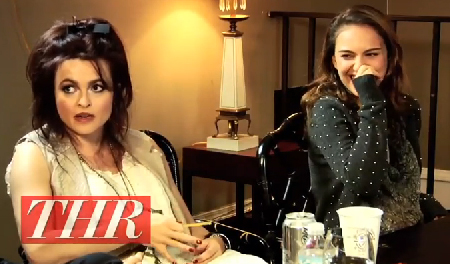
The actual hour-long Hollywood Reporter video of the six actresses who grace their cover: Annette Bening, Nicole Kidman, Amy Adams, Hilary Swank, Natalie Portman and Helena Bonham-Carter. Here's how it breaks down if you don't have a full hour to watch (video at bottom of post). Unfortunately you can't "scroll" so the time stamps are useless as I type away.
0:01 Helena talks about first day-i-tis. Never thinks she can do it. I can't act! 1:30 Amy talks about being unemployed and feeling sorry for herself (interesting bit... both sad and funny) and the long time period where she considered giving up. But now that she's successful, what doesn't she like about her career?
Amy: I feel very vulnerable. I don't like it at all. You're very subject to other people's opinions. You know when it doesn't go well.
Hilary: We know when it doesn't go well. We don't need to be beat over the head with it.
Oopsie!
5:00 Swank talks about trying and even if you fail, always try your hardest. Ah platitudes! I didn't get enough of 'em on election night. 6:48 Annette is asked about her input into making The Kids Are All Right more of a comedy than it originally started as...
Annette: I just didn't want it to be earnest. But she's (Lisa Cholodenko) also kind of too generous when she talks about me and my contributions.
9:00 Helena interrupts to talk about the vibrator scene (but says she hasn't seen the movie). 10:30 Hilary complains that she can't find good comedies. Uhnnh, you're not a comic actress. We're 10 minutes in and Nicole has said NOTHING. I need Nicki. But she was like this at the Margot at the Wedding press conference I attended, too. She is kind of robotic until directly addressed. I say that with the utmost love but it's like she's a robot until the movie camera is on or the press cameras are off. It's... odd. 12:00 Natalie Portman calls the Black Swan screenplay "a blueprint." and reveals that she and Darren Aronofsky have been planning to make the movie for the past 9 years (!) and credits Nicole with the following great career advice...
Natalie: Nicole said it to me a long time ago when we were doing Cold Mountain. 'Always choose by director. You never know how the movie is going to turn out but you're guaranteed an interesting experience.' I've always remembered that.
Oh bless you, Nicole. We knew this about you already. Strangely, Nicole hasn't seen Black Swan.
16:00 Nicole speaks! She lists the plentiful injuries she got on Moulin Rouge! after the other actresses keep egging her on. The actresses discuss moments when you should say no, or call it a night, but you keep going. The knee injury, which took two years to recover from, happened at 3 AM.
Nicole: When you're so in the role, it's almost like a high. It's like a drug. There's no way I was going to stop.
Oh, we knew this about her, too. 18:00 Amy follows that up with a story about Leap Year. No really.
Nicole's "what was that?" love affair.
19:00 Nicole is praised again about something from outside this conversation (clearly the woman is more animated when she's not doing press) and asked if she's ever had conflict with a director. She seems confused by the question (bless) and says instead
Nicole: It's like a love affair for a certain period of time and then I walk away and go 'what was that?!?'
...which gets a big laugh from the other five. I know people think I'm undiscerning when it comes to Kidman but the truth is I deeply dig actresses who are auteurists at heart. Truth: They're always the most interesting ones.
Annette "Balance" Bening
20:00 Unfortunately then she starts talking about not feeling the same pull to work anymore. Damnit! Thankfully, Annette amends this, explaining that even though she went through that once she had children, the desire to work returns and there is something about the acting process that fulfills you in a way that you can't get elsewhere. Having a balanced life "sounds good" but...
Annette: Creativity is really about excess and when you want to make something there's a kind of obsession that has to come with it -- in a healthy way, in a way that is intoxicating. You're engulfed by something.
(Are you listening Michelle Pfeiffer? Come Back to the Five and Dime Michelle Pfeiffer, Michelle Pfeiffer.) She then goes on to reveal that she wanted the Debra Winger role in The Sheltering Sky.
25:00 Hilary refuses to rest on her laurels (would that be two Oscars?) and reveals a knowledge of writers and seeks out screenplays that aren't even sent to her. Good for her (I'm not saying that facetiously.) Talks about a part she didn't get and Annette teases her about it. 26:00 Nicole Kidman has seen Star Trek. She bought a ticket and everything (?). Hilary doesn't like science fiction. (Is that distaste a post-The Core problem? She doesn't say.)
Amy exfoliates
28:00 Amy vows to spend time with her daughter instead of doing movies -- damn you, infant! KIDDING! please no one bite my head off though infants have taken many of the great actresses away from us. And this conversation is further proof. (Sigh) 29:00 Nicole considered not making Rabbit Hole after having Sunday and struggling for financing. This part is a snooze fest.
31:00 Hilary and Amy talk about not doing certain roles and how it's disrespectful to the actor who did it to talk about roles you wanted or turned down. Natalie says that if directors vacillate about who to cast it's not a good sign "never a good sign" actually. It shows they don't know what they want. Hilary vaguely claims to have been"coerced" into certain roles. By whom? Are we talking about The Core again? Let it go! 32:00 Amy reveals panic about super tight close-ups and wondering if she exfoliated properly. I hate those too, Amy! But for different reasons. I like to see like hair, shoulders, hands. I want to see how the actor uses their body, not just their eyes nose and maybe top lip.
Helena continually cracks Natalie up.
33:00 INTERESTING. Now we're getting into it. Helena Bonham-Carter talks about her discomfort with Lars Von Trier (!)..."but I didn't realize this man was a visionary". Admits she turned down Breaking the Waves. Natalie Portman is very excited about this reveal. Nicole says it's one of her favorite films (of course it is!) which eggs Helena on in the story. HBC thinks it was really weird that Emily Watson told everyone (she did? I don't remember this) that Helena had turned it down 'because that film made her!'
35:00 Helena talks about her 'late bloomer' personality and that she's finally comfortable with her sexuality. 'There were lots of parts I was just not ready for.' This all makes me wonder how the hell she got through The Wings of the Dove (1997) in which she is freakishly perfect and totally erotic, too. And for which she won the Oscar (SHHHHHhhhhh. Let me live in my fantasy world where deserving things happen.) 36:00 Nicole says she still e-mails Lars Von Trier (!) but agrees that he can be mean. The moderator brings up The Five Obstructions as an interesting portrait of Lars. Nicole "I don't need to see that. I worked with him."
38:00 Helena discusses Tim Burton at length but tells a great story about befriending a focus puller on Sweeney Todd who totally helped her get more takes since Tim wouldn't give them too her. 43:00 I am totally losing focus now as The Bening discusses stage vs screen. 45:00 Interesting... she's giving a lot of credit to Milos Forman for helping her to understand film acting. Funny that she brings this up because I was just watching Valmont again the other day and she is really quite fantastic in it and its' about a 180 from Glenn Close's interpretation of the same role.
The Bening as the evil Merquise de Merteuil
Watching them back to back would surely remind us that no two actors will give you the same thing. Ever. (Now, admittedly the cast, director and screenplay are different, too. But still. They are SO different within the exact same story / character.)
The Bening kicks the story up a notch by imitating Forman's directions in his voice. 47:00 Okay now I love Milos Forman more than I ever have in my life. Natalie loves Annette's story and shares her own (also in Forman's voice from her time with him on Goya's Ghost)
Natalie: You're acting like you're in -- like this is a bad movie. This is not a bad movie. This is a good movie. Annette: That is brilliant
48:00 Nicole tells a Jane Campion story! No way. Okay this is getting better and better. It's a story about a Jane Campion short she pulled out of because she didn't want to wear a shower cap OR kiss a girl. 'I was 14. I wanted to kiss boys!' Hahaha. 50:00 Amy Adams calls the moderator on his "baiting" when he is talking about movies being only made for young boys now. None of them take the bait except Hilary.... 51:00 ...who weirdly goes on a bizarre tangent blaming critics (!) for the failure of dramas. Yeah, that's right. Ticket buyers totally listen to unemployed critics. 'Critics don't like linear storytelling anymore!' They don't? This is news to me.
52:00 Nicole and Helena both praise HBO and TV in general (?) Kidman says she's doing something for HBO. She is? I so cannot keep up with upcoming movie news. 54:00 Amy hates that being an actress means you're supposed to also be a model. Helena tells her she doesn't have to pretend to be a model. 'Wear whatever you like. You'll get criticized for it but..." Helena would know. 56:00 Natalie explains that she was lucky to finish high school before the internet explosion of actors having no privacy. She can't imagine what the famous teens go through now. Nicole says she wishes she had been a director instead of an actress (!) 58:00 Annette talks about the "crazy intimacy" of acting and goes on and on and on and on some more about how acting really has very little to do with the acoutrements of fame and red carpets and whatnot. Interesting stuff if I weren't already exhausted and since i can't rewind, I can't quote anymore.
Here's the whole interview if you have the hour.
Some armchair possibly inaccurate observations:
Helena Bonham-Carter is very funny.
Hilary and Annette both talk with their hands a lot .
Nicole & Natalie are both shy but not inattentive
Amy Adams doesn't want to be in this room at all. ( But hey, she's got an infant daughter. She's justifiably distracted. We'll cut her some slack.)