
Tampilkan postingan dengan label travel. Tampilkan semua postingan
Tampilkan postingan dengan label travel. Tampilkan semua postingan
Kamis, 25 April 2013
A £1 House in U.K.
Homes in Stoke-on-Trent which can be bought for just £1
More than 600 people are interested in buying rundown homes in Stoke-on-Trent for £1 each, the city council has said.

Thirty-five derelict homes, mainly two-bedroom terraced properties, will initially be sold off in the Cobridge area, with a further 89 to follow.
Under the £3m project, the local authority is offering loans of up to £30,000 to help complete essential repairs on the houses.
Applications opened for potential buyers on Monday.
People have until 12 May to apply for one.
Stoke-on-Trent City Council said the initial 35 homes would be randomly allocated to the successful applicants.
The majority are two-bedroom, but there are also a few three-bedroom houses and possibly some flats.
Anyone applying must have lived in the city for the past three years.
Other criteria they must satisfy include:
A joint income of £18,000 to £25,000 a year – £30,000 maximum if they have children
Applicants must have been employed for the past two years
They must not own another property
They must have the right to live permanently in the UK
The new house must be their main home for at least five years
‘Community spirit’
Anyone taking out the £30,000 loan would have to pay it back within 10 years at an interest rate of 3% above the Bank of England base rate, which currently stands at 0.5%.
If the house is sold within 10 years, a proportion of any profit must be paid to the council on a sliding scale.
In return for buying the properties, people will be required to renovate them and bring them back into use.
Councillor Janine Bridges, responsible for housing, said the scheme would “see a rundown area of the city transformed”.
She added: “The project will not only benefit the residents who are currently living next door to properties that have been vacant for some time, it will also give families moving into the homes the chance to take their first step on the property ladder.”
The council said it hoped to “build a community spirit” in the area and create “thriving neighbourhoods”.
However, Steph Dunn-Fox, from Stoke-on-Trent-based estate agents findahomeonline.co.uk, said Cobridge was presently an unattractive area for home buyers and was “full of empty homes”.
She said: “I think it’s a great idea in principle and they’re probably thinking it’ll appeal most to first-time buyers.
“It’s the sort of area and offer that could appeal to property developers, but they’re excluded from this.
“It’s difficult – unless you’re from the area, who wants to live on a rundown street, carry out a lot of work and know you have to stay there for at least five years?”
She said she could see a typical terrace house redeveloped in a good condition reaching a maximum of £55,000 to £60,000 on the market.
Last month, Liverpool City Council said more than 2,000 people had been in touch about buying 20 homes there during the week they were on offer for £1.
More than 600 people are interested in buying rundown homes in Stoke-on-Trent for £1 each, the city council has said.

Thirty-five derelict homes, mainly two-bedroom terraced properties, will initially be sold off in the Cobridge area, with a further 89 to follow.
Under the £3m project, the local authority is offering loans of up to £30,000 to help complete essential repairs on the houses.
Applications opened for potential buyers on Monday.
People have until 12 May to apply for one.
Stoke-on-Trent City Council said the initial 35 homes would be randomly allocated to the successful applicants.
The majority are two-bedroom, but there are also a few three-bedroom houses and possibly some flats.
Anyone applying must have lived in the city for the past three years.
Other criteria they must satisfy include:
A joint income of £18,000 to £25,000 a year – £30,000 maximum if they have children
Applicants must have been employed for the past two years
They must not own another property
They must have the right to live permanently in the UK
The new house must be their main home for at least five years
‘Community spirit’
Anyone taking out the £30,000 loan would have to pay it back within 10 years at an interest rate of 3% above the Bank of England base rate, which currently stands at 0.5%.
If the house is sold within 10 years, a proportion of any profit must be paid to the council on a sliding scale.
In return for buying the properties, people will be required to renovate them and bring them back into use.
Councillor Janine Bridges, responsible for housing, said the scheme would “see a rundown area of the city transformed”.
She added: “The project will not only benefit the residents who are currently living next door to properties that have been vacant for some time, it will also give families moving into the homes the chance to take their first step on the property ladder.”
The council said it hoped to “build a community spirit” in the area and create “thriving neighbourhoods”.
However, Steph Dunn-Fox, from Stoke-on-Trent-based estate agents findahomeonline.co.uk, said Cobridge was presently an unattractive area for home buyers and was “full of empty homes”.
She said: “I think it’s a great idea in principle and they’re probably thinking it’ll appeal most to first-time buyers.
“It’s the sort of area and offer that could appeal to property developers, but they’re excluded from this.
“It’s difficult – unless you’re from the area, who wants to live on a rundown street, carry out a lot of work and know you have to stay there for at least five years?”
She said she could see a typical terrace house redeveloped in a good condition reaching a maximum of £55,000 to £60,000 on the market.
Last month, Liverpool City Council said more than 2,000 people had been in touch about buying 20 homes there during the week they were on offer for £1.
Rabu, 24 April 2013
The Bulgarian Mystery
Belogradchik, Bulgaria - The Belogradchik Rocks and the Belogradchik Fortress
Danube River Cruise Shore Excursion from the Viking Neptune


The Belogradchik Rocks (Bulgarian: Белоградчишки скали, Belogradchishki skali) are a group of strange shaped sandstone and conglomerate rock formations located on the western slopes of the Balkan Mountains (Stara Planina) near the town of Belogradchik in northwest Bulgaria. The rocks vary in color from primarily red to yellow; some of the rocks reach up to 200 m in height. Many rocks have fantastic shapes and are associated with interesting legends. They are often named for people or objects they are thought to resemble. The Belogradchik Rocks have been declared a Natural Landmark by the Bulgarian government and are a major tourist attraction in the region.
The Belogradchik Rocks (also spelled Belogradshick or Belogradschik) are one of the natural wonders of Bulgaria. These huge reddish limestone and sandstone rocks tower over the small town of Belogradchik and form part of the walls of the Belogradchik Fortress, which was first built by the Romans about 100 AD.
Danube River cruises in eastern Europe often include a half-day at Belogradchik from Vidin so that passengers can stroll the streets of the town and climb the numerous steps and ladders to the top of the Belogradchik Rock formations. The view from the top is spectacular, and knowing that many of the old steps date back to Roman times makes the walk even more interesting. Those who have mobility problems can still enjoy the Belogradchik rocks and fortress from very near where the coach parks at the entrance to the Belogradchik Fortress.
At first glance, one might think these photos were from the Southwestern part of the USA, until the Roman walls and Bulgarian signage are sighted!
Danube River Cruise Shore Excursion from the Viking Neptune


The Belogradchik Rocks (Bulgarian: Белоградчишки скали, Belogradchishki skali) are a group of strange shaped sandstone and conglomerate rock formations located on the western slopes of the Balkan Mountains (Stara Planina) near the town of Belogradchik in northwest Bulgaria. The rocks vary in color from primarily red to yellow; some of the rocks reach up to 200 m in height. Many rocks have fantastic shapes and are associated with interesting legends. They are often named for people or objects they are thought to resemble. The Belogradchik Rocks have been declared a Natural Landmark by the Bulgarian government and are a major tourist attraction in the region.
The Belogradchik Rocks (also spelled Belogradshick or Belogradschik) are one of the natural wonders of Bulgaria. These huge reddish limestone and sandstone rocks tower over the small town of Belogradchik and form part of the walls of the Belogradchik Fortress, which was first built by the Romans about 100 AD.
Danube River cruises in eastern Europe often include a half-day at Belogradchik from Vidin so that passengers can stroll the streets of the town and climb the numerous steps and ladders to the top of the Belogradchik Rock formations. The view from the top is spectacular, and knowing that many of the old steps date back to Roman times makes the walk even more interesting. Those who have mobility problems can still enjoy the Belogradchik rocks and fortress from very near where the coach parks at the entrance to the Belogradchik Fortress.
At first glance, one might think these photos were from the Southwestern part of the USA, until the Roman walls and Bulgarian signage are sighted!
Selasa, 23 April 2013
The World's Deadliest Prison
Locked Up Abroad Gulag Style! Inside The Unbelievably Harsh Conditions Of Russia’s Labor Camps


Going to the bathroom outside when it’s -4 degrees. Only seeing your children two to four times a year. Bathing just once a week. And vying with dozens of other prisoners one hour a week to use one of two phone booths to call home.
This is just a little insight into the harsh reality of life inside Russian’s modern day labor camps, known under Stalin as gulags.
And these are the conditions that two members of the band Pussy Riot will face when they arrive at two of Russia’s most notorious penal facilities.
In August, a judge convicted Maria Alyokhina, 24, and Nadezhda Tolokonnikova, 22, of “hooliganism” for performing in a Moscow cathedral.
As the news previously reported, both received a two-year sentence and this week they were put on trains to separate camps in the remote areas of Mordovia and Perm.
Svetlana Bakhmina, a lawyer who spent four years in one such camp after being convicted of embezzlement, reveals the harsh realities of life as
an inmate.
“From the moment you stepped into the train, you were no longer recognized as an equal human being – the system treats you as a second-class person,” she tells the Daily Beast.
“They make you jump out of a prison vehicle into the train’s door. You fly with all your bags over about [a] 3 feet gap while guards with dogs stand on the ground watching you.”
Tolokonnikova will serve her time in the Mordovia colony FGU IK-14 that was once Bakhmina’s home. According to the lawyer, the train journey takes about two days and two nights.
Kept in crowded cages, she says the women are only allowed to use the bathroom twice. The rest of the time they have to improvise.
Bakhmina told BBC News that the facility is like a “tough, Soviet-style camp.” She said: “The inmates were all housed in two big army-style barracks – there were anywhere between 50 and 100 people in each one.
“The barracks were built in the Soviet times – I guess in the 1920s.”
While each barrack is furnished with rows of bunk beds, a nightstand and a stool, the bathroom facilities are dire.
She says: “There is also a toilet but you cannot use it as there is no central sewage system. We used to go outside to the so-called ‘hole’, sometimes when it was -20C [-4 degrees] in the winter.”
Woken at 6 a.m. the women have to exercise outside – even in freezing conditions – before doing their daily chores.
Both Alyokhina and Tolokonnikova are moms of young children but communication with loved ones will be limited according to insiders. Inmates can only see their families two to four times a year during three-day visits.
Meanwhile each unit is only given an hour a week to call home. Bakhmina remembers vying with dozens of women to use one of two phone booths to talk to her young sons.
The picture the lawyer presents is a gloomy one – of being locked up with murderers and facing a constant threat of violence.
She says: “The administration was very strict with us – rumors of beatings circled around the colony, although I didn’t witness any personally.
“More often there were fights between the inmates themselves.”
Perhaps the biggest threat the inmates face is a psychological one.
Bakhmina says: “There was no torture…but anyone disobeying the prison rules would be punished by getting sent to ‘shiza’ [Russian abbreviation for ‘schizophrenia’] – a solitary cell.”


Going to the bathroom outside when it’s -4 degrees. Only seeing your children two to four times a year. Bathing just once a week. And vying with dozens of other prisoners one hour a week to use one of two phone booths to call home.
This is just a little insight into the harsh reality of life inside Russian’s modern day labor camps, known under Stalin as gulags.
And these are the conditions that two members of the band Pussy Riot will face when they arrive at two of Russia’s most notorious penal facilities.
In August, a judge convicted Maria Alyokhina, 24, and Nadezhda Tolokonnikova, 22, of “hooliganism” for performing in a Moscow cathedral.
As the news previously reported, both received a two-year sentence and this week they were put on trains to separate camps in the remote areas of Mordovia and Perm.
Svetlana Bakhmina, a lawyer who spent four years in one such camp after being convicted of embezzlement, reveals the harsh realities of life as
an inmate.
“From the moment you stepped into the train, you were no longer recognized as an equal human being – the system treats you as a second-class person,” she tells the Daily Beast.
“They make you jump out of a prison vehicle into the train’s door. You fly with all your bags over about [a] 3 feet gap while guards with dogs stand on the ground watching you.”
Tolokonnikova will serve her time in the Mordovia colony FGU IK-14 that was once Bakhmina’s home. According to the lawyer, the train journey takes about two days and two nights.
Kept in crowded cages, she says the women are only allowed to use the bathroom twice. The rest of the time they have to improvise.
Bakhmina told BBC News that the facility is like a “tough, Soviet-style camp.” She said: “The inmates were all housed in two big army-style barracks – there were anywhere between 50 and 100 people in each one.
“The barracks were built in the Soviet times – I guess in the 1920s.”
While each barrack is furnished with rows of bunk beds, a nightstand and a stool, the bathroom facilities are dire.
She says: “There is also a toilet but you cannot use it as there is no central sewage system. We used to go outside to the so-called ‘hole’, sometimes when it was -20C [-4 degrees] in the winter.”
Woken at 6 a.m. the women have to exercise outside – even in freezing conditions – before doing their daily chores.
Both Alyokhina and Tolokonnikova are moms of young children but communication with loved ones will be limited according to insiders. Inmates can only see their families two to four times a year during three-day visits.
Meanwhile each unit is only given an hour a week to call home. Bakhmina remembers vying with dozens of women to use one of two phone booths to talk to her young sons.
The picture the lawyer presents is a gloomy one – of being locked up with murderers and facing a constant threat of violence.
She says: “The administration was very strict with us – rumors of beatings circled around the colony, although I didn’t witness any personally.
“More often there were fights between the inmates themselves.”
Perhaps the biggest threat the inmates face is a psychological one.
Bakhmina says: “There was no torture…but anyone disobeying the prison rules would be punished by getting sent to ‘shiza’ [Russian abbreviation for ‘schizophrenia’] – a solitary cell.”
The World's Worst Hotel
Wanted: Ugly people for travel ads
Ugly writer crafts beautiful article calling for honest, realistic travel marketing -- pretty people will not enjoy this

 Ads lie. Or they did.
The golf vacation commercials are the worst. All those beaming glad-I-came-here faces. After a shank off the first and a round of 118? Not counting 11 lost balls?
It’s impossible for any real golfer to look that happy.
Beach holiday ads are no better. Everyone perfectly formed, no cellulite or growths.
No one looking like they’ve been born in the normal, mammalian way, like you see on real beaches.
Unreally happy families having a wonderfully elated time at a great price with no sign of disharmony, dysfunction or diarrhea.
Couples staring dreamily through candlelight and walking hand in hand through the moonlit Caribbean surf, with no sign of her shenanigans the day before with the hotel’s beach raker.
And the cruises: photo after photo of laughing faces having a once-in-a-lifetime time over a very small portion of fish. Which looks bigger in a close-up.
No sign of anyone seasick or cabin-bound. No pictures taken at the exact moment the dinner table conversation stalled on the first night: “Why did you come on this cruise?”
“Because we have a high superlative threshold and are easily deceived by advertising copy.”
No hint of anyone being tortured by the crooner with the fire-retardant toupee; by the excessively talkative couple from Winnipeg; the extremely cheerful couple from Wales; the husband who memorizes Android reviews and the wife who collects digitalized photos of her master bedroom.
And pronounces Muscadet Muscadette.
No ad can communicate a real vacation and its petty but enervating frustrations.
And that’s to be expected.
But there are signs that as travelers get savvy to the tricks and illusions of marketers, marketers are now becoming savvy to our savvy.
Ugly, the new pretty
I’m an honorary member of the “Ugly Club of the World.” I received the accolade in the self-nominated ugliest place in the world.
The Club dei Brutti is based in Piobbico in the Marche region of mid-Italy. It has 30,000 members worldwide and hosts an ugly persons’ festival every September.
The town square even has an ugly statue.
Amsterdam’s acclaimed Hans Brinker Budget Hotel has been “proudly disappointing travelers for 40 years.”
Its unashamedly filthy rooms are sold out months in advance through sheer honesty, comic in its frankness and superb negative hyperbole.
Its marketing slogan is: “We can’t get any worse but we try our best.”
It waives liability for gastroenteritis, mental breakdown and even lost limbs.
It boasts a bar serving slightly watered down beer and facilities comparable to a prison. One ad proclaims: “Now even more dogsh*t in the main entrance.”
Another shows a figure collapsed on the ground with its head caught in the hostel’s doors, surrounded by an ever-widening puddle of vomit -- a new and successful style of gushing endorsement.
Is all this clever marketing? Or just simple truth that attracts backpackers on a budget and a bender?
Probably both.
What exactly are they advertising?
Being bombarded by perfect breasts and gorgeous men from every holiday brochure and mortgage maturity leaflet I ever picked up gets to me.
Cruise commercials don’t make me go out and book a cruise. They make me go out and get some dental fixative. The only thing that sticks in my head is the teeth.
Recent surveys suggest we no longer trust celebrity endorsement, especially of beauty products. Scarlett Johannsen before and after? Unlikely.
One poll also revealed that 78% of TV viewers believe the people in laxative ads are really actors faking being constipated. Method actors having it the hardest.
It’s time for ads to use normal people with realistic bodies and facial expressions. Someone not so happy. Someone not very photogenic.
Someone with shoulder hair rather than shoulder-length hair. Someone more like me.
It wouldn’t be a totally original concept.
One of the earliest examples of this kind of inverse marketing/reverse psychology came from an Irish realty agent who wrote straight-talking property descriptions along the refreshingly honest lines of, “The décor is revolting and the lack of insulation has attracted insects. Otherwise, there is nothing much wrong.’”
That was in the 1960s.
It proved a productive hook with people flocking up to see just how bad the houses were.
Copywriters need to bin the superlatives and “We’ve found paradise! Come join us!” approach.
They need to realize there’s no such thing as paradise, especially if other people are there and all the loungers have gone.
As my Ugly Club friends keep telling me: “Us uglies must unite to overcome. We are better and stronger than the beautiful people. And there are far more of us.”
It’s all summed up by the recent Southern Comfort commercial.
An astigmatic, middle-aged potbelly in sea waders and tight trunks that could double as an eye patch waddles contentedly down a beach, accompanied by Odetta’s “Gotta Be Me.”
Perhaps body shape losers may not be flocking to the Barcelona beach where the ad was shot, but its aspirational message is clear.
Don’t hype up. Hype down. To the naked truth. Democratize. Don’t idealize. Tell it like it is. And show it how it is.
Get real.
Perhaps then we might not be so frequently disappointed when we get there.
Piobicco has put itself on the map. Being ugly is its Unique Selling Point. It bills itself as a place ugly people can feel at home.
And it’s effective. They come in their hideous hordes, ramping up the tourism income while battering down the beauty factor.
The Czech Republic has gone the same way.
It sells itself to bad skiers, offering “numerous ravishing sceneries” and flat, snowy places where “you can enjoy the nature while struggling to ski” and meet “not very capable skiers.”
Superbeings and posers are not targeted. So everyone else can have a good time. Hard or soft sell, it works. Because it’s different. And funny. And true.
Ugly writer crafts beautiful article calling for honest, realistic travel marketing -- pretty people will not enjoy this


The golf vacation commercials are the worst. All those beaming glad-I-came-here faces. After a shank off the first and a round of 118? Not counting 11 lost balls?
It’s impossible for any real golfer to look that happy.
Beach holiday ads are no better. Everyone perfectly formed, no cellulite or growths.
No one looking like they’ve been born in the normal, mammalian way, like you see on real beaches.
Unreally happy families having a wonderfully elated time at a great price with no sign of disharmony, dysfunction or diarrhea.
Couples staring dreamily through candlelight and walking hand in hand through the moonlit Caribbean surf, with no sign of her shenanigans the day before with the hotel’s beach raker.
And the cruises: photo after photo of laughing faces having a once-in-a-lifetime time over a very small portion of fish. Which looks bigger in a close-up.
No sign of anyone seasick or cabin-bound. No pictures taken at the exact moment the dinner table conversation stalled on the first night: “Why did you come on this cruise?”
“Because we have a high superlative threshold and are easily deceived by advertising copy.”
No hint of anyone being tortured by the crooner with the fire-retardant toupee; by the excessively talkative couple from Winnipeg; the extremely cheerful couple from Wales; the husband who memorizes Android reviews and the wife who collects digitalized photos of her master bedroom.
And pronounces Muscadet Muscadette.
No ad can communicate a real vacation and its petty but enervating frustrations.
And that’s to be expected.
But there are signs that as travelers get savvy to the tricks and illusions of marketers, marketers are now becoming savvy to our savvy.
Ugly, the new pretty
I’m an honorary member of the “Ugly Club of the World.” I received the accolade in the self-nominated ugliest place in the world.
The Club dei Brutti is based in Piobbico in the Marche region of mid-Italy. It has 30,000 members worldwide and hosts an ugly persons’ festival every September.
The town square even has an ugly statue.
Amsterdam’s acclaimed Hans Brinker Budget Hotel has been “proudly disappointing travelers for 40 years.”
Its unashamedly filthy rooms are sold out months in advance through sheer honesty, comic in its frankness and superb negative hyperbole.
Its marketing slogan is: “We can’t get any worse but we try our best.”
It waives liability for gastroenteritis, mental breakdown and even lost limbs.
It boasts a bar serving slightly watered down beer and facilities comparable to a prison. One ad proclaims: “Now even more dogsh*t in the main entrance.”
Another shows a figure collapsed on the ground with its head caught in the hostel’s doors, surrounded by an ever-widening puddle of vomit -- a new and successful style of gushing endorsement.
Is all this clever marketing? Or just simple truth that attracts backpackers on a budget and a bender?
Probably both.
What exactly are they advertising?
Being bombarded by perfect breasts and gorgeous men from every holiday brochure and mortgage maturity leaflet I ever picked up gets to me.
Cruise commercials don’t make me go out and book a cruise. They make me go out and get some dental fixative. The only thing that sticks in my head is the teeth.
Recent surveys suggest we no longer trust celebrity endorsement, especially of beauty products. Scarlett Johannsen before and after? Unlikely.
One poll also revealed that 78% of TV viewers believe the people in laxative ads are really actors faking being constipated. Method actors having it the hardest.
It’s time for ads to use normal people with realistic bodies and facial expressions. Someone not so happy. Someone not very photogenic.
Someone with shoulder hair rather than shoulder-length hair. Someone more like me.
It wouldn’t be a totally original concept.
One of the earliest examples of this kind of inverse marketing/reverse psychology came from an Irish realty agent who wrote straight-talking property descriptions along the refreshingly honest lines of, “The décor is revolting and the lack of insulation has attracted insects. Otherwise, there is nothing much wrong.’”
That was in the 1960s.
It proved a productive hook with people flocking up to see just how bad the houses were.
Copywriters need to bin the superlatives and “We’ve found paradise! Come join us!” approach.
They need to realize there’s no such thing as paradise, especially if other people are there and all the loungers have gone.
As my Ugly Club friends keep telling me: “Us uglies must unite to overcome. We are better and stronger than the beautiful people. And there are far more of us.”
It’s all summed up by the recent Southern Comfort commercial.
An astigmatic, middle-aged potbelly in sea waders and tight trunks that could double as an eye patch waddles contentedly down a beach, accompanied by Odetta’s “Gotta Be Me.”
Perhaps body shape losers may not be flocking to the Barcelona beach where the ad was shot, but its aspirational message is clear.
Don’t hype up. Hype down. To the naked truth. Democratize. Don’t idealize. Tell it like it is. And show it how it is.
Get real.
Perhaps then we might not be so frequently disappointed when we get there.
Piobicco has put itself on the map. Being ugly is its Unique Selling Point. It bills itself as a place ugly people can feel at home.
And it’s effective. They come in their hideous hordes, ramping up the tourism income while battering down the beauty factor.
The Czech Republic has gone the same way.
It sells itself to bad skiers, offering “numerous ravishing sceneries” and flat, snowy places where “you can enjoy the nature while struggling to ski” and meet “not very capable skiers.”
Superbeings and posers are not targeted. So everyone else can have a good time. Hard or soft sell, it works. Because it’s different. And funny. And true.
This Tree Can Sing !
Singing Ringing Tree


One of the most iconic artworks in Lancashire, the fascinating ‘Singing Ringing Tree’ at Crown Point high on the moors above Burnley is one of four Panopticons, part of a project across East Lancashire led by Mid Pennine Arts.
Designed by architects Tonkin-Liu the sculpture resembles a windblown tree; it is constructed from scaffolding poles welded together in concentric circles, the pipes having been tuned to emit a melodious hum as the wind blows through them.
The splendid views over the town to the hills beyond make a visit for a closer inspection of this amazing artwork an absolute must. The sculpture is only a short walk from the carpark and picnic area but if you enjoy longer walks then the best route is the Wayside Arts Trail from Towneley Park; follow its carved Lancashire oak marker posts and bricks including a brick kiln by artist Julie Miles to take a closer look at this incredible landmark.
It is obvious that there is something about Burnley that is attractive to award-winning architects Mike Tonkin and Anna Liu because they have now returned to design Burnley’s latest public artwork the Rain Bow Gate. Located at the heart of Burnley’s new Knowledge quarter, the design is a bow structure that integrates glass prisms to capture light and create rainbows, evoking a sence of wonder.


One of the most iconic artworks in Lancashire, the fascinating ‘Singing Ringing Tree’ at Crown Point high on the moors above Burnley is one of four Panopticons, part of a project across East Lancashire led by Mid Pennine Arts.
Designed by architects Tonkin-Liu the sculpture resembles a windblown tree; it is constructed from scaffolding poles welded together in concentric circles, the pipes having been tuned to emit a melodious hum as the wind blows through them.
The splendid views over the town to the hills beyond make a visit for a closer inspection of this amazing artwork an absolute must. The sculpture is only a short walk from the carpark and picnic area but if you enjoy longer walks then the best route is the Wayside Arts Trail from Towneley Park; follow its carved Lancashire oak marker posts and bricks including a brick kiln by artist Julie Miles to take a closer look at this incredible landmark.
It is obvious that there is something about Burnley that is attractive to award-winning architects Mike Tonkin and Anna Liu because they have now returned to design Burnley’s latest public artwork the Rain Bow Gate. Located at the heart of Burnley’s new Knowledge quarter, the design is a bow structure that integrates glass prisms to capture light and create rainbows, evoking a sence of wonder.
The Reasons Why You Shoul Never Bring Condoms To States
'Detained for carrying condoms, sexy undies'

A WOMAN claims she was detained by US border officials three times in two weeks and accused of being a sex worker for having condoms and "racy underwear" in her luggage.
University of British Columbia graduate Clay Nikiforuk (a pseudonym) wrote an article for the Huffington Post about the "baffling" series of events that occurred as she travelled through the US with a married man.
"What do you do when you're detained by powerful officials, everything you say is presumed deceptive, arbitrary 'evidence' is held against you, and you're treated like a moral deviant? And what if it's 2013, you're a woman, and the "evidence" is that you possess condoms?" asked Nikiforuk in a book on the sociology of sexual assault.
Nikiforuk said she was first held by border guards in Vermont in March, where her bag was searched "at least five times". She had approximately eight condoms in her suitcase and underwear.
"I could not help but notice how often my lingerie and 'sexy underwear' were mentioned, how often the condoms they found were looked upon scathingly, and how most of the four male officers' questions pertained to both," she said.
"I was like, 'Yeah, some girls like shoes, I like nice underwear', and then realised it was really not funny. They were taking it very seriously… and looking at my condoms and counting them.
"I was baffled as to why this was any of their business and unsure of what their objective was."
She was eventually granted a limited two-week visa, but she'd missed her bus and plane by that time so had to wait until the next morning to continue her journey.
Two weeks later she alleged Montreal Airport officials took her into a back office and interrogated her about the man she was travelling with.
During the questioning she admitted the man was married and she was planning on sharing a hotel bed with him. Nikiforuk was forced to tell the official that the man's wife "doesn't want to know the details, but she knows" about their affair.
"The next thing I knew he was searching my bags, pulling out condoms and waving them in my face," she said.
"He said: 'I could have you charged with being a working girl! The proof is right here'."
She was asked: "How much is he paying you to go on this trip?". When she answered that she wasn't being paid, she was told off for participating in adultery and let go.
Next came Miami, where she claims she was detained, interrogated, fingerprinted, patted down and "yelled at" for eight hours and asked: "Are you looking to be sexually assaulted?" when she told the official she was writing a book on the sociology of sexual assault.
She has filed a complaint over the incident, claiming she was the victim of a sexist double standard.
US immigration lawyer Steve Goldstein told Canada's Metro News that he's never heard of someone being denied entry to the US because they were carrying condoms.
US Customs and Border Patrol told news.com.au they cannot comment due to privacy laws
"Due to privacy laws, US Customs and Border Protection is prohibited from discussing specific cases or individuals," a US Customs and Border Patrol spokesperson said. "CBP strives to treat all travellers with respect and in a professional manner, preserving the civil rights and civil liberties of all people with whom the officers and agents interact while maintaining the focus of our mission to protect all citizens and visitors in the United States.
"CBP stresses honour and integrity in every aspect of our mission, and the overwhelming majority of CBP employees and officers perform their duties with honor and distinction, working tirelessly every day to keep our country safe."
A WOMAN claims she was detained by US border officials three times in two weeks and accused of being a sex worker for having condoms and "racy underwear" in her luggage.
University of British Columbia graduate Clay Nikiforuk (a pseudonym) wrote an article for the Huffington Post about the "baffling" series of events that occurred as she travelled through the US with a married man.
"What do you do when you're detained by powerful officials, everything you say is presumed deceptive, arbitrary 'evidence' is held against you, and you're treated like a moral deviant? And what if it's 2013, you're a woman, and the "evidence" is that you possess condoms?" asked Nikiforuk in a book on the sociology of sexual assault.
Nikiforuk said she was first held by border guards in Vermont in March, where her bag was searched "at least five times". She had approximately eight condoms in her suitcase and underwear.
"I could not help but notice how often my lingerie and 'sexy underwear' were mentioned, how often the condoms they found were looked upon scathingly, and how most of the four male officers' questions pertained to both," she said.
"I was like, 'Yeah, some girls like shoes, I like nice underwear', and then realised it was really not funny. They were taking it very seriously… and looking at my condoms and counting them.
"I was baffled as to why this was any of their business and unsure of what their objective was."
She was eventually granted a limited two-week visa, but she'd missed her bus and plane by that time so had to wait until the next morning to continue her journey.
Two weeks later she alleged Montreal Airport officials took her into a back office and interrogated her about the man she was travelling with.
During the questioning she admitted the man was married and she was planning on sharing a hotel bed with him. Nikiforuk was forced to tell the official that the man's wife "doesn't want to know the details, but she knows" about their affair.
"The next thing I knew he was searching my bags, pulling out condoms and waving them in my face," she said.
"He said: 'I could have you charged with being a working girl! The proof is right here'."
She was asked: "How much is he paying you to go on this trip?". When she answered that she wasn't being paid, she was told off for participating in adultery and let go.
Next came Miami, where she claims she was detained, interrogated, fingerprinted, patted down and "yelled at" for eight hours and asked: "Are you looking to be sexually assaulted?" when she told the official she was writing a book on the sociology of sexual assault.
She has filed a complaint over the incident, claiming she was the victim of a sexist double standard.
US immigration lawyer Steve Goldstein told Canada's Metro News that he's never heard of someone being denied entry to the US because they were carrying condoms.
US Customs and Border Patrol told news.com.au they cannot comment due to privacy laws
"Due to privacy laws, US Customs and Border Protection is prohibited from discussing specific cases or individuals," a US Customs and Border Patrol spokesperson said. "CBP strives to treat all travellers with respect and in a professional manner, preserving the civil rights and civil liberties of all people with whom the officers and agents interact while maintaining the focus of our mission to protect all citizens and visitors in the United States.
"CBP stresses honour and integrity in every aspect of our mission, and the overwhelming majority of CBP employees and officers perform their duties with honor and distinction, working tirelessly every day to keep our country safe."
Minggu, 21 April 2013
Naked Rollercoaster - The Bumper Crowd of Nudes
Naked rollercoaster 'record broken' in Essex

102 naked people on Adventure Island in Essex broke the previous world record for the most naked people to ride a roller-coaster (previously held by 32 people at Alton towers).
"The rollercoaster ran three times to accommodate the bumper crowd of nudes"
Though this wasn't some kind of random nude happenstance, but a event to raise money for Southend Hospital Charitable Foundation to buy cancer screening equipment.
"More than £22,000 was raised for charity."

102 naked people on Adventure Island in Essex broke the previous world record for the most naked people to ride a roller-coaster (previously held by 32 people at Alton towers).
"The rollercoaster ran three times to accommodate the bumper crowd of nudes"
Though this wasn't some kind of random nude happenstance, but a event to raise money for Southend Hospital Charitable Foundation to buy cancer screening equipment.
"More than £22,000 was raised for charity."
Helsinki Naked Run

Sabtu, 20 April 2013
The World's Rudest Countries for Travelers
World's 10 rudest countries for travelers
Travelers aren't always welcome, and some people let you know it
 Travelers love Paris, but do Parisians love them back?
Travel search site Skyscanner recently released a list of the world’s rudest nations for visitors, naming the countries whose smiley and friendly natives are apparently confined to their promotional videos.
The result, which lists 34 countries, is based on Skyscanner’s online poll, which received more than 1,200 responses from Europe, North America and Australia.
France, the champion of impoliteness
La Belle France was declared the champion of impoliteness, garnering nearly 20 percent of the total votes.
French people are known for “their abrupt and curt nature,” especially while facing foreign tourists, Edinburgh-based Skyscanner told International Business Times.
Russia took second place with 16.6 percent of the votes, followed by the United Kingdom (10.4 percent), Germany (9.93 percent) and a puzzingly labeled “Others” (miscellaneous countries).
China (4.3 percent) ranked sixth on the list, leading Asia.
Language barriers and cultural differences are the main causes
China-based etiquette expert Lawrence Lo (卢浩研) pointed out that language barriers and cultural differences are the two major players behind the ranking.
“The French are very protective of their language, and customers can get different responses for ordering in French or in another language,” said Lo.
Yi Bao, Skyscanner marketing manager for China, gave an example to back the "culture difference" theory.
According to Yi, though queuing is a social norm in the West, it’s not a common behavior for Chinese people, “so [it] could be interpreted as being rude [by international travelers.]”
The personality of hospitality staff is another contributing factor.
Lo said many restaurants’ waiting staff in Chinese cities are usually young women from rural areas, and that the Chinese are naturally more shy than Westerners.
“[These waitresses] don’t have the confidence or language skill to handle foreign travelers. Sometimes, they’d rather avoid them,” said Lo.
“On the other hand, a lot of French waiters have worked in this position their whole life, so they have a superiority complex in front of travelers.”
Lo also said the result of the survey depended on what type of travelers were voting.
"For many backpackers, challenges in language and culture actually form part of the fun of traveling," said Lo.
Here are the 10 rudest countries on Skyscanner’s list:
1. France
2. Russia
3. United Kingdom
4. Germany
5. Others
6. China
7. United States
8. Spain
9. Italy
10. Poland
The countries voted least rude were:
25. Japan
26. Denmark
27. Canada
28. New Zealand
29. Indonesia
30. Portugal
31. Thailand
32. The Philippines
33. Caribbean region
34. Brazil
Travelers aren't always welcome, and some people let you know it

Travel search site Skyscanner recently released a list of the world’s rudest nations for visitors, naming the countries whose smiley and friendly natives are apparently confined to their promotional videos.
The result, which lists 34 countries, is based on Skyscanner’s online poll, which received more than 1,200 responses from Europe, North America and Australia.
France, the champion of impoliteness
La Belle France was declared the champion of impoliteness, garnering nearly 20 percent of the total votes.
French people are known for “their abrupt and curt nature,” especially while facing foreign tourists, Edinburgh-based Skyscanner told International Business Times.
Russia took second place with 16.6 percent of the votes, followed by the United Kingdom (10.4 percent), Germany (9.93 percent) and a puzzingly labeled “Others” (miscellaneous countries).
China (4.3 percent) ranked sixth on the list, leading Asia.
Language barriers and cultural differences are the main causes
China-based etiquette expert Lawrence Lo (卢浩研) pointed out that language barriers and cultural differences are the two major players behind the ranking.
“The French are very protective of their language, and customers can get different responses for ordering in French or in another language,” said Lo.
Yi Bao, Skyscanner marketing manager for China, gave an example to back the "culture difference" theory.
According to Yi, though queuing is a social norm in the West, it’s not a common behavior for Chinese people, “so [it] could be interpreted as being rude [by international travelers.]”
The personality of hospitality staff is another contributing factor.
Lo said many restaurants’ waiting staff in Chinese cities are usually young women from rural areas, and that the Chinese are naturally more shy than Westerners.
“[These waitresses] don’t have the confidence or language skill to handle foreign travelers. Sometimes, they’d rather avoid them,” said Lo.
“On the other hand, a lot of French waiters have worked in this position their whole life, so they have a superiority complex in front of travelers.”
Lo also said the result of the survey depended on what type of travelers were voting.
"For many backpackers, challenges in language and culture actually form part of the fun of traveling," said Lo.
Here are the 10 rudest countries on Skyscanner’s list:
1. France
2. Russia
3. United Kingdom
4. Germany
5. Others
6. China
7. United States
8. Spain
9. Italy
10. Poland
The countries voted least rude were:
25. Japan
26. Denmark
27. Canada
28. New Zealand
29. Indonesia
30. Portugal
31. Thailand
32. The Philippines
33. Caribbean region
34. Brazil
Rabu, 17 April 2013
Climb The Mountain to Go to SCHOOL - COOL !
That's one to get to the top of the class… The terrifying climb of Chinese schoolchildren as young as five forced to scale sheer cliffs to get to school
Mountain-top village of only 100 residents is cut off from the outside world, apart from ladders leading to valley below
Brave schoolchildren use the wooden ladders with no safety precautions to get to school every day
Five-year-old Liu Dan explained: 'It's quite high but I try not to look down'
Terrifying: Children clamber down these unsecured ladders to get to school in Hunan province, China

 Isolated: The village in the steep mountains where the children set off from every day to go to the valley below
These schoolchildren in southern China are so keen to get to school that they make the perilous journey on narrow wooden ladders every day, with no safety precautions.
Their village in the remote Badagong mountains in Sangzhi county is surrounded by sheer drops on every side, making the school run a daily struggle.
The only way out of Zhang Jiawan village, unless the children have time for a four-hour cross country detour, is via a series of rickety-looking ladders leading down to the valley.
Their anxious parents have no choice but to let them use the ladders if they want to get an education.
So when youngsters like five-year-old Liu Dan start school at the nearest town, the first thing they have to learn is how to climb.
'In centuries past these mountains were a fortress for the villagers. The land is good and the farms thrive but it is hard to get in and out,' said one local.
Liu admitted: 'It's quite high but I try not to look down.'
'My parents showed me how to do it safely and now I don't think too much about how high it is,' she added.
Villagers have asked local officials to supply a road down to the valley so that these children do not have to risk their lilves.
However, the road over the difficult terrain would cost nearly £10 million so residents are not getting their hopes up that it will happen any time soon.
'There are fewer than 100 people living there. It would be cheaper to buy them all helicopters,' said one.
Mountain-top village of only 100 residents is cut off from the outside world, apart from ladders leading to valley below
Brave schoolchildren use the wooden ladders with no safety precautions to get to school every day
Five-year-old Liu Dan explained: 'It's quite high but I try not to look down'
Terrifying: Children clamber down these unsecured ladders to get to school in Hunan province, China


These schoolchildren in southern China are so keen to get to school that they make the perilous journey on narrow wooden ladders every day, with no safety precautions.
Their village in the remote Badagong mountains in Sangzhi county is surrounded by sheer drops on every side, making the school run a daily struggle.
The only way out of Zhang Jiawan village, unless the children have time for a four-hour cross country detour, is via a series of rickety-looking ladders leading down to the valley.
Their anxious parents have no choice but to let them use the ladders if they want to get an education.
So when youngsters like five-year-old Liu Dan start school at the nearest town, the first thing they have to learn is how to climb.
'In centuries past these mountains were a fortress for the villagers. The land is good and the farms thrive but it is hard to get in and out,' said one local.
Liu admitted: 'It's quite high but I try not to look down.'
'My parents showed me how to do it safely and now I don't think too much about how high it is,' she added.
Villagers have asked local officials to supply a road down to the valley so that these children do not have to risk their lilves.
However, the road over the difficult terrain would cost nearly £10 million so residents are not getting their hopes up that it will happen any time soon.
'There are fewer than 100 people living there. It would be cheaper to buy them all helicopters,' said one.
Selasa, 16 April 2013
Extraordinary International Building Without Any Corners
Zaha Hadid Architects’ has completed the Galaxy Soho office, retail and entertainment complex in Beijing


The new Galaxy Soho project is a 330,000 sq m commercial complex that includes office, retail and entertainment outlets. Designed by Zaha Hadid, the project is characterized by four large organic shaped concrete domes connected by a web of fluid bridges. Encased in concentric rings of insulated aluminum cladding, windows are stepped back slightly to provide daylighting and appropriate shading. Protected courtyards at the ground level connect shoppers to all the retail, which occupies the bottom floors.
The upper floors are occupied by office space and restaurants and bars at the top, which enjoy panoramic views of the city. Inside the domes, intimate courtyards create their own interior world and skylights light the space. The project has a LEED Silver rating due in part to its use of natural daylighting and tight envelope. The 18-floor complex has already sold out all of its commercial units and is regarded as a successful project.


The new Galaxy Soho project is a 330,000 sq m commercial complex that includes office, retail and entertainment outlets. Designed by Zaha Hadid, the project is characterized by four large organic shaped concrete domes connected by a web of fluid bridges. Encased in concentric rings of insulated aluminum cladding, windows are stepped back slightly to provide daylighting and appropriate shading. Protected courtyards at the ground level connect shoppers to all the retail, which occupies the bottom floors.
The upper floors are occupied by office space and restaurants and bars at the top, which enjoy panoramic views of the city. Inside the domes, intimate courtyards create their own interior world and skylights light the space. The project has a LEED Silver rating due in part to its use of natural daylighting and tight envelope. The 18-floor complex has already sold out all of its commercial units and is regarded as a successful project.
Old Water Tower Turned Into Luxury House
Stunning Water Tower Conversion in Belgium Bursting With Modern Details


Chateau d’Eau is the name of a striking project envisioned by BHAM design studio and consisting of a water tower conversion in Steenokkerzeel, Belgium.
The tower was built between 1938 and 1941 and was functional until the beginning of the nineties. The works for a complete renovation and conversion into a single family house started in 2007.
According to the architects, “the preservation of existing concrete elements such as the main water conduct, concrete ceilings, concrete stairs and the 250.000 liters concrete water basin were essential to preserve the strong identity of the building.
Every visible concrete element inside was painted in dark grey in order to mark the old from the new. The program foresees two distinct profiles of users. The private and main user is the client, a couple living at the tower daily. Every room is equipped with the latest IT technology, domotics and the possibility to install projectors virtually anywhere on the top floor”.
The unusual residence is thirty meters high and is structured on five floors. The terrace provides a great panoramic view of the nearby village.


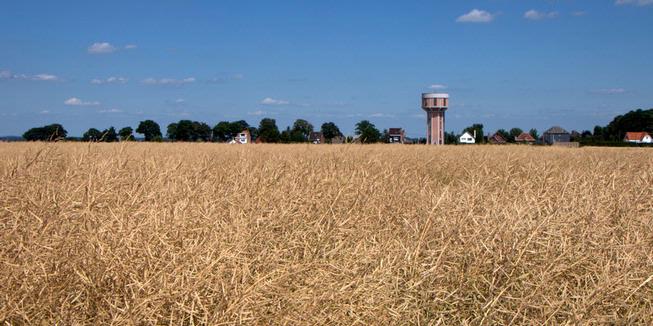

Chateau d’Eau is the name of a striking project envisioned by BHAM design studio and consisting of a water tower conversion in Steenokkerzeel, Belgium.
The tower was built between 1938 and 1941 and was functional until the beginning of the nineties. The works for a complete renovation and conversion into a single family house started in 2007.
According to the architects, “the preservation of existing concrete elements such as the main water conduct, concrete ceilings, concrete stairs and the 250.000 liters concrete water basin were essential to preserve the strong identity of the building.
Every visible concrete element inside was painted in dark grey in order to mark the old from the new. The program foresees two distinct profiles of users. The private and main user is the client, a couple living at the tower daily. Every room is equipped with the latest IT technology, domotics and the possibility to install projectors virtually anywhere on the top floor”.
The unusual residence is thirty meters high and is structured on five floors. The terrace provides a great panoramic view of the nearby village.
The Building with Funky Mesh Armor - Korean Art Center
Seoul's Kukje Art Centre


The Kukje Art Center in Seoul, South Korea is the latest awe-inspiring creating by New York-based SO-IL. The gallery is a concrete cube situated in the historic urban fabric of Sogyeok-dong, which is being populated by a series of low-rise boutique retail outlets and coffee shops. The structure is wrapped in a funky mesh armor that diffuses sunlight and softens the building's edges. Designed by Front Inc and prefabricated in China, the unique facade ensures the gallery sits in harmony with the neighborhood's character.
Comprised of thousands of small steel rings that together form a pliable envelope, the mesh facade wraps easily around the building, giving it an almost ethereal disguise that is altogether more interesting than concrete. But it also creates interesting shadow and diffuses excess solar gain. A massive space, the art center would exact a high energy load if it weren’t for certain interventions.
Given space restraints, SO-IL buried two of the gallery’s three levels underground and installed perimeter skylights that permit daylighting to penetrate deep into the interior, beyond the street level gallery, to cut down on energy requirements. And finally, circulation is kept to the edge of the building to maintain the clear span art space’s distinct geometry.


The Kukje Art Center in Seoul, South Korea is the latest awe-inspiring creating by New York-based SO-IL. The gallery is a concrete cube situated in the historic urban fabric of Sogyeok-dong, which is being populated by a series of low-rise boutique retail outlets and coffee shops. The structure is wrapped in a funky mesh armor that diffuses sunlight and softens the building's edges. Designed by Front Inc and prefabricated in China, the unique facade ensures the gallery sits in harmony with the neighborhood's character.
Comprised of thousands of small steel rings that together form a pliable envelope, the mesh facade wraps easily around the building, giving it an almost ethereal disguise that is altogether more interesting than concrete. But it also creates interesting shadow and diffuses excess solar gain. A massive space, the art center would exact a high energy load if it weren’t for certain interventions.
Given space restraints, SO-IL buried two of the gallery’s three levels underground and installed perimeter skylights that permit daylighting to penetrate deep into the interior, beyond the street level gallery, to cut down on energy requirements. And finally, circulation is kept to the edge of the building to maintain the clear span art space’s distinct geometry.
Senin, 15 April 2013
The World's Most Provocative Tourism Adverts
Tunisia defends 'provocative adverts' to woo tourists

 Tunisia's advertising agency says it wanted to be provocative in its campaign to attract tourists
Tunisia has defended a controversial advertising campaign to attract tourists who deserted the country after its revolution in January.
It includes billboards in London of a woman getting a massage, next to the words: "They say that in Tunisia some people receive heavy-handed treatment."
At least 200 people were killed during the Tunisian uprising which began in December.
It led to the collapse of President Zine al-Abidine Ben Ali's regime.
Tourism is crucial to Tunisia's economy. With a population of little more than 10 million people, the industry provides about 400,000 jobs and is worth about $2.5bn (£1.5bn) to the economy.
'Nothing but ruins'
Syrine Cherif, whose advertising agency Memac Ogilvy came up with the campaign for the Tunisian Tourism Board, said it was intended to create a "buzz" among potential tourists in the UK and other countries.
"The idea was to be provocative to address possible fears around the issue of the Arab spring," she told the BBC's Focus on Africa programme.
Other advertisements show ancient Roman ruins next to the words: "They say Tunisia is nothing but ruins."
She denied the campaign showed insensitivity towards Tunisians who had been jailed, tortured or killed during Mr Ben Ali's rule of 23 years.
"This unfair treatment was done by people who were in the dictatorship and now the dictatorship has gone. It's over. Today it's a new Tunisia," she said.
"The campaign is for foreigners, not targeting Tunisian people," she added.
Tunisia was the first country to be hit by the popular uprisings which have swept across North Africa and the Middle East.
Mr Ben Ali fled to Saudi Arabia in January after losing the support of the military.
His trial in absentia, for charges ranging from conspiring against the state to drug trafficking, starts on Monday.


Tunisia has defended a controversial advertising campaign to attract tourists who deserted the country after its revolution in January.
It includes billboards in London of a woman getting a massage, next to the words: "They say that in Tunisia some people receive heavy-handed treatment."
At least 200 people were killed during the Tunisian uprising which began in December.
It led to the collapse of President Zine al-Abidine Ben Ali's regime.
Tourism is crucial to Tunisia's economy. With a population of little more than 10 million people, the industry provides about 400,000 jobs and is worth about $2.5bn (£1.5bn) to the economy.
'Nothing but ruins'
Syrine Cherif, whose advertising agency Memac Ogilvy came up with the campaign for the Tunisian Tourism Board, said it was intended to create a "buzz" among potential tourists in the UK and other countries.
"The idea was to be provocative to address possible fears around the issue of the Arab spring," she told the BBC's Focus on Africa programme.
Other advertisements show ancient Roman ruins next to the words: "They say Tunisia is nothing but ruins."
She denied the campaign showed insensitivity towards Tunisians who had been jailed, tortured or killed during Mr Ben Ali's rule of 23 years.
"This unfair treatment was done by people who were in the dictatorship and now the dictatorship has gone. It's over. Today it's a new Tunisia," she said.
"The campaign is for foreigners, not targeting Tunisian people," she added.
Tunisia was the first country to be hit by the popular uprisings which have swept across North Africa and the Middle East.
Mr Ben Ali fled to Saudi Arabia in January after losing the support of the military.
His trial in absentia, for charges ranging from conspiring against the state to drug trafficking, starts on Monday.
The Most Creative Book Mountain
MVRDV completes Book Mountain and Library Quarter Spijkenisse


Close to the Port of Rotterdam docks, MVRDV has completed the Spijkenisse Book Mountain, a public library in Spijkenisse’s market square. It features a 480 meter route, lined with bookshelves, that wraps around a stacked, pyramidal form as it is showcased through the library’s glass structure. The “mountain of books” illuminates from within and serves as both an advertisement and an invitation to reading. The adjacent Library Quarter consisting of 42 social housing units, parking and public space is also a project by MVRDV. Together, with the Book Mountain, it strives to form an “exemplary eco-neighborhood”.
The library is designed as an advert for reading, its visible presence and invitation holding great significance for a community with 10 percent illiteracy. From underneath the glass dome the library is visible from all sides, especially from the adjacent market square where the library appears as one big book mountain. Underneath its monumental glass envelope damage to the books by sunlight is off-set by their normal 4 year life-span due to wear and tear from borrowing.
Located in the centre of Spijkenisse, the library with a total surface area of 9.300m2 sits on the market square next to the historical village church. Besides the library the building houses the environmental education centre, a chess club, auditorium, meeting rooms, commercial offices and retail. The exterior of the library refers in shape and materiality to the traditional Dutch Farm, a reminder of the towns agricultural past, which has grown from farming village to Ville Nouvelle in the past 40 years.
The library had to accommodate a number of other partly commercial functions. The stacking of this non-library program forms a pyramidal base on which platforms are projected, housing the libraries bookshelves and shaping a powerful symbol. The book platforms are connected via wide stairs and together form a continuous route of 480 meters around the mountain to its peak where a café offers panoramic views over this Dutch Newtown.
In order to connect the former village centre visually and distinguish clearly between commercial and library program, a ‘blanket’ of brick is laid over the neighborhood and the libraries pyramidal heart. The Library sits on top of this with its floors, walls, ceilings and even doors made of the same brick. This consequent materialization supports the public status of the library by communicating clearly the difference: behind the glass hood a library is visible, behind the brick sits the rest of the program.
Another reference to the towns agricultural past lies in the libraries bookshelves. Made of recycled flowerpots these elements are simultaneously fireproof and economic and provide a perfect background to the books and accompany the visitors through the building by taking on the functions of banister, parapet, information desk and bar. They form another element in the building’s palette of brick, glass and wood: recycled materials. Book shelves out of reach play an important visual role, housing the libraries archive.
Following the maximum permitted volume the Book Mountain is covered by a barn shaped glass envelope with wooden trusses resulting in a transparent almost open air library. Underneath the glass is a public space without air conditioning. In summer natural ventilation and sun screens result in a comfortable indoor climate, in winter under-floor heating and double glazing maintain a stable interior environment. The climate system is based on an innovative combination of proven technology such as underground heat and cold storage, natural ventilation and many other interventions. The award winning invisible integrated technology was developed by Arcadis in collaboration with MVRDV.
The new public library is part of a larger plan to strengthen and intensify the town centre. MVRDV have also designed the neighboring development of 42 houses for a local housing corporation. The apartments inside the plan vary strongly in size, from studio apartments to housing fit for large families, attracting a more diverse urban population. A folly-like tilted house is the centre of this ensemble of abstract traditional typologies: contemporary reference instead of nostalgic replica. Housing and library share a common materiality, public space and environmental technology. In terms of identity the project resembles an out of scale farm, at the same time referring to, and becoming, a monument to the agricultural past of Spijkenisse, and its growth towards a city. On the new market square the outlines of buildings demolished during the 1960’s mark the old centre which has been turned now into a new village centre for a growing town, not nostalgic yet respecting the history.
The development of Book Mountain and the Library Quarter is currently translated into literature: titled “Make Some Noise”, later this year a mix between literature and photo novel will be published by 010/NAi Publishers describing the almost ten years it took realizing the project.


Close to the Port of Rotterdam docks, MVRDV has completed the Spijkenisse Book Mountain, a public library in Spijkenisse’s market square. It features a 480 meter route, lined with bookshelves, that wraps around a stacked, pyramidal form as it is showcased through the library’s glass structure. The “mountain of books” illuminates from within and serves as both an advertisement and an invitation to reading. The adjacent Library Quarter consisting of 42 social housing units, parking and public space is also a project by MVRDV. Together, with the Book Mountain, it strives to form an “exemplary eco-neighborhood”.
The library is designed as an advert for reading, its visible presence and invitation holding great significance for a community with 10 percent illiteracy. From underneath the glass dome the library is visible from all sides, especially from the adjacent market square where the library appears as one big book mountain. Underneath its monumental glass envelope damage to the books by sunlight is off-set by their normal 4 year life-span due to wear and tear from borrowing.
Located in the centre of Spijkenisse, the library with a total surface area of 9.300m2 sits on the market square next to the historical village church. Besides the library the building houses the environmental education centre, a chess club, auditorium, meeting rooms, commercial offices and retail. The exterior of the library refers in shape and materiality to the traditional Dutch Farm, a reminder of the towns agricultural past, which has grown from farming village to Ville Nouvelle in the past 40 years.
The library had to accommodate a number of other partly commercial functions. The stacking of this non-library program forms a pyramidal base on which platforms are projected, housing the libraries bookshelves and shaping a powerful symbol. The book platforms are connected via wide stairs and together form a continuous route of 480 meters around the mountain to its peak where a café offers panoramic views over this Dutch Newtown.
In order to connect the former village centre visually and distinguish clearly between commercial and library program, a ‘blanket’ of brick is laid over the neighborhood and the libraries pyramidal heart. The Library sits on top of this with its floors, walls, ceilings and even doors made of the same brick. This consequent materialization supports the public status of the library by communicating clearly the difference: behind the glass hood a library is visible, behind the brick sits the rest of the program.
Another reference to the towns agricultural past lies in the libraries bookshelves. Made of recycled flowerpots these elements are simultaneously fireproof and economic and provide a perfect background to the books and accompany the visitors through the building by taking on the functions of banister, parapet, information desk and bar. They form another element in the building’s palette of brick, glass and wood: recycled materials. Book shelves out of reach play an important visual role, housing the libraries archive.
Following the maximum permitted volume the Book Mountain is covered by a barn shaped glass envelope with wooden trusses resulting in a transparent almost open air library. Underneath the glass is a public space without air conditioning. In summer natural ventilation and sun screens result in a comfortable indoor climate, in winter under-floor heating and double glazing maintain a stable interior environment. The climate system is based on an innovative combination of proven technology such as underground heat and cold storage, natural ventilation and many other interventions. The award winning invisible integrated technology was developed by Arcadis in collaboration with MVRDV.
The new public library is part of a larger plan to strengthen and intensify the town centre. MVRDV have also designed the neighboring development of 42 houses for a local housing corporation. The apartments inside the plan vary strongly in size, from studio apartments to housing fit for large families, attracting a more diverse urban population. A folly-like tilted house is the centre of this ensemble of abstract traditional typologies: contemporary reference instead of nostalgic replica. Housing and library share a common materiality, public space and environmental technology. In terms of identity the project resembles an out of scale farm, at the same time referring to, and becoming, a monument to the agricultural past of Spijkenisse, and its growth towards a city. On the new market square the outlines of buildings demolished during the 1960’s mark the old centre which has been turned now into a new village centre for a growing town, not nostalgic yet respecting the history.
The development of Book Mountain and the Library Quarter is currently translated into literature: titled “Make Some Noise”, later this year a mix between literature and photo novel will be published by 010/NAi Publishers describing the almost ten years it took realizing the project.
New Zealand Pornographic
Kapiti logo 'mildly pornographic'
 UNDER REVIEW: How Kapiti's new tourism logo might be used in branding.
A rebrand of Kapiti's tourism image may be tweaked to include the word "coast" amid suggestions its logo looks pornographic or like the Loch Ness monster.
The logo, part of a $30,000 Kapiti Coast District Council contract, polarised opinion when unveiled at last week's meeting.
It includes a 'k', shaped, and coloured green and blue, to look like a mountain and the sea. Underneath is the single word: "Kapiti".
Councillor Tony Lester backed the logo, which he said was "absolutely excellent".
"We've positioned ourselves for the future, it captures the hills, and the coast, and it captures our future as more of a city."
Others did not agree. Councillor Hilary Wooding said she did not like the 'k', which looked "cut in half".
Councillor Ross Church said the logo was not consistent with council branding and the 'k' would spark all sorts of comments about exactly what it depicts.
"I showed it to a Scots person who said 'it looks like the Loch Ness monster on legs'."
In the public speaking session, Otaki Community Board member Jackie Elliott raised the possibility the logo could be perceived as lewd.
"I have had feedback from the public that this 'k' image with its bent leg, at the knee, is more than mildly pornographic. Perhaps the caption underneath could be 'come to Kapiti and let the earth move for you'."
However most debate at the meeting centred on whether the word "coast", and its associations, should be included in the logo.
Strategic projects manager Philippa Richardson said the decision was based on the idea that Kapiti is much more than just a coast.
Kapiti's Eden Design won the bid to produce the marketing brand that will be owned by the council, but available to all tourism operators.
Councillors voted to delay a decision to approve the logo till a demonstration image including "coast" is presented.
Mr Lester voted against the decision, keen to approve the logo as it stands.
On the question of whether the logo is lewd, Mr Lester said as far as he was concerned "pornography is in the eye of the beholder".

A rebrand of Kapiti's tourism image may be tweaked to include the word "coast" amid suggestions its logo looks pornographic or like the Loch Ness monster.
The logo, part of a $30,000 Kapiti Coast District Council contract, polarised opinion when unveiled at last week's meeting.
It includes a 'k', shaped, and coloured green and blue, to look like a mountain and the sea. Underneath is the single word: "Kapiti".
Councillor Tony Lester backed the logo, which he said was "absolutely excellent".
"We've positioned ourselves for the future, it captures the hills, and the coast, and it captures our future as more of a city."
Others did not agree. Councillor Hilary Wooding said she did not like the 'k', which looked "cut in half".
Councillor Ross Church said the logo was not consistent with council branding and the 'k' would spark all sorts of comments about exactly what it depicts.
"I showed it to a Scots person who said 'it looks like the Loch Ness monster on legs'."
In the public speaking session, Otaki Community Board member Jackie Elliott raised the possibility the logo could be perceived as lewd.
"I have had feedback from the public that this 'k' image with its bent leg, at the knee, is more than mildly pornographic. Perhaps the caption underneath could be 'come to Kapiti and let the earth move for you'."
However most debate at the meeting centred on whether the word "coast", and its associations, should be included in the logo.
Strategic projects manager Philippa Richardson said the decision was based on the idea that Kapiti is much more than just a coast.
Kapiti's Eden Design won the bid to produce the marketing brand that will be owned by the council, but available to all tourism operators.
Councillors voted to delay a decision to approve the logo till a demonstration image including "coast" is presented.
Mr Lester voted against the decision, keen to approve the logo as it stands.
On the question of whether the logo is lewd, Mr Lester said as far as he was concerned "pornography is in the eye of the beholder".
Minggu, 14 April 2013
The World's Most Mysterious Buildings
The world's most mysterious buildings
 The Woodchester Mansion in the Cotswolds region of England. It was abandoned midconstruction in 1873.
Mysteries come in many forms: ancient, modern, unsolved and unexplained. But the world's most mysterious buildings are a physical force to be reckoned with.
They've become popularized on websites such as abandoned-places.com, weburbanist.com and the granddaddy of them all, atlasobscura.com, an exhaustive user-generated and editor-curated database of the unusual.
Our list of mysteries doesn't trot out cliched write-ups of the Bermuda Triangle and the Egyptian pyramids, nor is it promoting the usual suspects of PR-pushed haunted hotels. These peculiar structures are original, lesser-known and often arcane.
Mystery, after all, must be authentic.
"In an age where it sometimes seems like there's nothing left to discover, our site is for people who still believe in exploration," says Atlas Obscura co-founder Joshua Foer, whose own favorite mysterious buildings include a murder mansion in Los Angeles and an art house in Centralia, Washington.
Our definition of mysterious is broad and varied. Some buildings on our list are being eaten alive by the Earth, such as a sand-swallowed lighthouse in Denmark's Jutland and a lava-buried church in the remote highlands of Mexico. Others have design elements that seem to defy logic or were mysteriously abandoned by their people centuries ago. New York's shadowy Renwick Smallpox Hospital has more recent traces of human life -- and an eerie energy that lingers. We've got the photo proof.
Renwick Hospital, Roosevelt Island, New York City
This abandoned Smallpox Hospital, replete with granite veneer, corbelled parapets and mansard roofs, is a reminder of Gotham's grisly past. Its 100 hospital beds once hosted quarantined immigrants suffering from the gruesome disease. A $4.5 million restoration project will open Renwick to the public in 2013, kicking off with an art project that includes giant butterflies hovering over the site.
Mystery: Renwick is illuminated at night by an anonymous patron, who purportedly has a view of it from an Upper East Side penthouse.
Visit: The American Institute of Architects and Classic Harbor Line offer architecture-themed cruises around Manhattan with lectures on Renwick and other mysterious city sites.
Loretto Chapel, Santa Fe, New Mexico
The imposing Gothic Revival church's spiral staircase is a woodwork masterpiece that somehow connects the choir loft to the ground-level pews without a central column for stability and with wooden pegs instead of nails.
Mystery: Legend has it that an anonymous carpenter built the staircase in 1878 then disappeared without pay.
Visit: Just around the corner is La Posada de Santa Fe, a three-story Victorian mansion turned art-stuffed hotel. Suite 100 was the bedroom of previous owner Julia Staab, and her spirit is said to haunt it.
Kolmanskop Diamond Camp, Skeleton Coast, Namibia
Bushmen considered Namibia's Skeleton Coast "The Land God Made in Anger," while the Portuguese called it "The Gates of Hell." Though the coast received its name because of beached whale bones that scattered its shores during the heyday of the whaling industry, today skeletal remains of more than 1,000 fog-sacked ships and abandoned diamond camps earn it the title. Among the detritus being taken over by desert sands is Minenvewalter, the manager's house at abandoned diamond mine Kolmanskop.
Mystery: Diamond miners purportedly haunt Minenvewalter; their ax-pick-punctured skulls were allegedly found here in the 1960s long after the colony departed.
Visit: Wilderness Safari's Distinctive Namibia circuit includes lion and cheetah treks in the rusty dunes but also a scenic three-hour flight over the wreck-strewn Skeleton Coast.
Skara Brae, Orkney Islands, Scotland
Previously thought to be a Pictish village, this massive and mysterious Orcadian village on the Bay of Skaill is still being excavated -- and changing everything we know about Europe's pre-Celtic era in the process. The 5,000-year-old site predates the Egyptian pyramids.
Mystery: Even though the village was deserted thousands of years ago, the buildings at Skara Brae remain in good condition. Archaeologists don't know why the last inhabitants left, although many theorize it was abandoned because of an apocalyptic event.
Visit: Hurtigruten's "In the Wake of the Vikings" cruise calls on ports in the ancient Orkneys, as well as the Shetlands, Hebrides and Faroes.
Woodchester Mansion, Cotswolds, England
Stone gargoyles festoon this 19th-century neo-Gothic mansion topped with turrets and built of iconic honey-colored Cotswold limestone. It was abandoned midconstruction in 1873 after its devoutly Catholic owner died. Seek out the mansion amid a deeply secluded valley for bat tours, Halloween parties and paranormal nights.
Mystery: During World War II, the house was used as a temporary morgue for Allied troops. Rumors persist of uniform-wearing spirits and 1940s music echoing in the hallways.
Visit: Twenty miles away in Cheltenham, the newly opened Ellenborough Park is a gorgeous 16th-century Tudor-style manor with all the posh benefits of your own mansion.
Therme Vals, Vals, Switzerland
High in the Swiss Alps at the end of a terminal road in a Romansh-speaking pocket of Canton Graubünden is this stark thermal bath designed by Pritzker laureate Peter Zumthor. Slabs of Valser quartzite create a watery labyrinth that's by turns minimalist and quasi-industrial, but consistently eerie.
Mystery: The grottenbad (acoustic chamber) is accessed by a narrow tunnel and allows bathers' vibratos to bounce off the walls, creating a delightfully haunting aural experience.
Visit: Earn some soak time in the bath with Country Walkers' self-guided Walk of the Valais and Goms Valley.
Yaxchilán, Chiapas, Mexico
This obscure fourth-century site, along the Usumacinta River at the Guatemala border, draped in thick strangler vines and echoing with shrieking howler monkeys, is a tourist-free standout among Mexico's many ruins. Visitors approach by boat, then enter through El Laberinto (The Labyrinth), a limestone building with painted stucco panels and topped with decorative cresterías dedicated to ruler kings such as Moon Skull.
Mystery: Yaxchilán was mysteriously deserted in the ninth century, but pilings along each side of the river suggest that it was the site of a sophisticated suspension bridge.
Visit: Travel like Mayans, by water, on Mountain Travel Sobek's Chiapas Wildlife Adventure, which includes whitewater-rafting runs along the Rio Santo Domingo and stops at Yaxchilán and other ancient ruins.
Rubjerg Knude Lighthouse, Hjørring, Denmark
Jutting out from a desolate dune called Lønstrup Klint (cliff), this ghostly sentinel was built in 1900 but abandoned in 1968 after sands and sea began to devour it whole. The sturdy 75-foot-tall building will likely collapse from shifting sands and coastal erosion in the next decade -- and it makes you wonder what other Viking relics lie beneath the sand.
Mystery: The tower was built on a dune-less cliff 656 feet from the sea and nearly 200 feet above sea level, yet, despite rescue attempts, the elements slowly swallowed it over the years.
Visit: Twenty miles north is a Danish Modernist country house steps from a more tranquil beach.
San Juan Parangaricutiro, Michoacán, Mexico
In 1943, an explosive volcano in Mexico's remote mountain state of Michoacán began spewing lava, eventually burying the villages of San Juan Parangaricutiro and Paricutín under a coal-black layer of chunky lava.
Mystery: The crucifix-topped bell tower of the San Juan Parangaricutiro Church just so happened to be spared from the destructive lava, while the vacated church's altar, at the other end of the church, is also entirely intact.
Visit: Abercrombie & Kent's tailor-made Mexican Colonial Splendors trip takes you to the lava-buried site from the Purépecha mountain village of Angahuan, 30 minutes away.
Coral Castle, Homestead, Florida
Made from 1,100 tons of limestone boulders -- bigger than those at Stonehenge -- this structure, located just south of Miami, was built from 1923 to 1951 by a single man, a tiny Latvian immigrant named Edward Leedskalnin, as his home and an homage to the love of his life who left him the night before their wedding.
Mystery: How did he do it? The jilted man claimed he knew the secret to the pyramids' construction. Other details -- no mortar, precise seams, physics-defying balancing acts -- have also stumped scientists for decades.
Visit: Take a guided tour for some insights into this quirky castle, where even the rocking chairs are made of stone.

Mysteries come in many forms: ancient, modern, unsolved and unexplained. But the world's most mysterious buildings are a physical force to be reckoned with.
They've become popularized on websites such as abandoned-places.com, weburbanist.com and the granddaddy of them all, atlasobscura.com, an exhaustive user-generated and editor-curated database of the unusual.
Our list of mysteries doesn't trot out cliched write-ups of the Bermuda Triangle and the Egyptian pyramids, nor is it promoting the usual suspects of PR-pushed haunted hotels. These peculiar structures are original, lesser-known and often arcane.
Mystery, after all, must be authentic.
"In an age where it sometimes seems like there's nothing left to discover, our site is for people who still believe in exploration," says Atlas Obscura co-founder Joshua Foer, whose own favorite mysterious buildings include a murder mansion in Los Angeles and an art house in Centralia, Washington.
Our definition of mysterious is broad and varied. Some buildings on our list are being eaten alive by the Earth, such as a sand-swallowed lighthouse in Denmark's Jutland and a lava-buried church in the remote highlands of Mexico. Others have design elements that seem to defy logic or were mysteriously abandoned by their people centuries ago. New York's shadowy Renwick Smallpox Hospital has more recent traces of human life -- and an eerie energy that lingers. We've got the photo proof.
Renwick Hospital, Roosevelt Island, New York City
This abandoned Smallpox Hospital, replete with granite veneer, corbelled parapets and mansard roofs, is a reminder of Gotham's grisly past. Its 100 hospital beds once hosted quarantined immigrants suffering from the gruesome disease. A $4.5 million restoration project will open Renwick to the public in 2013, kicking off with an art project that includes giant butterflies hovering over the site.
Mystery: Renwick is illuminated at night by an anonymous patron, who purportedly has a view of it from an Upper East Side penthouse.
Visit: The American Institute of Architects and Classic Harbor Line offer architecture-themed cruises around Manhattan with lectures on Renwick and other mysterious city sites.
Loretto Chapel, Santa Fe, New Mexico
The imposing Gothic Revival church's spiral staircase is a woodwork masterpiece that somehow connects the choir loft to the ground-level pews without a central column for stability and with wooden pegs instead of nails.
Mystery: Legend has it that an anonymous carpenter built the staircase in 1878 then disappeared without pay.
Visit: Just around the corner is La Posada de Santa Fe, a three-story Victorian mansion turned art-stuffed hotel. Suite 100 was the bedroom of previous owner Julia Staab, and her spirit is said to haunt it.
Kolmanskop Diamond Camp, Skeleton Coast, Namibia
Bushmen considered Namibia's Skeleton Coast "The Land God Made in Anger," while the Portuguese called it "The Gates of Hell." Though the coast received its name because of beached whale bones that scattered its shores during the heyday of the whaling industry, today skeletal remains of more than 1,000 fog-sacked ships and abandoned diamond camps earn it the title. Among the detritus being taken over by desert sands is Minenvewalter, the manager's house at abandoned diamond mine Kolmanskop.
Mystery: Diamond miners purportedly haunt Minenvewalter; their ax-pick-punctured skulls were allegedly found here in the 1960s long after the colony departed.
Visit: Wilderness Safari's Distinctive Namibia circuit includes lion and cheetah treks in the rusty dunes but also a scenic three-hour flight over the wreck-strewn Skeleton Coast.
Skara Brae, Orkney Islands, Scotland
Previously thought to be a Pictish village, this massive and mysterious Orcadian village on the Bay of Skaill is still being excavated -- and changing everything we know about Europe's pre-Celtic era in the process. The 5,000-year-old site predates the Egyptian pyramids.
Mystery: Even though the village was deserted thousands of years ago, the buildings at Skara Brae remain in good condition. Archaeologists don't know why the last inhabitants left, although many theorize it was abandoned because of an apocalyptic event.
Visit: Hurtigruten's "In the Wake of the Vikings" cruise calls on ports in the ancient Orkneys, as well as the Shetlands, Hebrides and Faroes.
Woodchester Mansion, Cotswolds, England
Stone gargoyles festoon this 19th-century neo-Gothic mansion topped with turrets and built of iconic honey-colored Cotswold limestone. It was abandoned midconstruction in 1873 after its devoutly Catholic owner died. Seek out the mansion amid a deeply secluded valley for bat tours, Halloween parties and paranormal nights.
Mystery: During World War II, the house was used as a temporary morgue for Allied troops. Rumors persist of uniform-wearing spirits and 1940s music echoing in the hallways.
Visit: Twenty miles away in Cheltenham, the newly opened Ellenborough Park is a gorgeous 16th-century Tudor-style manor with all the posh benefits of your own mansion.
Therme Vals, Vals, Switzerland
High in the Swiss Alps at the end of a terminal road in a Romansh-speaking pocket of Canton Graubünden is this stark thermal bath designed by Pritzker laureate Peter Zumthor. Slabs of Valser quartzite create a watery labyrinth that's by turns minimalist and quasi-industrial, but consistently eerie.
Mystery: The grottenbad (acoustic chamber) is accessed by a narrow tunnel and allows bathers' vibratos to bounce off the walls, creating a delightfully haunting aural experience.
Visit: Earn some soak time in the bath with Country Walkers' self-guided Walk of the Valais and Goms Valley.
Yaxchilán, Chiapas, Mexico
This obscure fourth-century site, along the Usumacinta River at the Guatemala border, draped in thick strangler vines and echoing with shrieking howler monkeys, is a tourist-free standout among Mexico's many ruins. Visitors approach by boat, then enter through El Laberinto (The Labyrinth), a limestone building with painted stucco panels and topped with decorative cresterías dedicated to ruler kings such as Moon Skull.
Mystery: Yaxchilán was mysteriously deserted in the ninth century, but pilings along each side of the river suggest that it was the site of a sophisticated suspension bridge.
Visit: Travel like Mayans, by water, on Mountain Travel Sobek's Chiapas Wildlife Adventure, which includes whitewater-rafting runs along the Rio Santo Domingo and stops at Yaxchilán and other ancient ruins.
Rubjerg Knude Lighthouse, Hjørring, Denmark
Jutting out from a desolate dune called Lønstrup Klint (cliff), this ghostly sentinel was built in 1900 but abandoned in 1968 after sands and sea began to devour it whole. The sturdy 75-foot-tall building will likely collapse from shifting sands and coastal erosion in the next decade -- and it makes you wonder what other Viking relics lie beneath the sand.
Mystery: The tower was built on a dune-less cliff 656 feet from the sea and nearly 200 feet above sea level, yet, despite rescue attempts, the elements slowly swallowed it over the years.
Visit: Twenty miles north is a Danish Modernist country house steps from a more tranquil beach.
San Juan Parangaricutiro, Michoacán, Mexico
In 1943, an explosive volcano in Mexico's remote mountain state of Michoacán began spewing lava, eventually burying the villages of San Juan Parangaricutiro and Paricutín under a coal-black layer of chunky lava.
Mystery: The crucifix-topped bell tower of the San Juan Parangaricutiro Church just so happened to be spared from the destructive lava, while the vacated church's altar, at the other end of the church, is also entirely intact.
Visit: Abercrombie & Kent's tailor-made Mexican Colonial Splendors trip takes you to the lava-buried site from the Purépecha mountain village of Angahuan, 30 minutes away.
Coral Castle, Homestead, Florida
Made from 1,100 tons of limestone boulders -- bigger than those at Stonehenge -- this structure, located just south of Miami, was built from 1923 to 1951 by a single man, a tiny Latvian immigrant named Edward Leedskalnin, as his home and an homage to the love of his life who left him the night before their wedding.
Mystery: How did he do it? The jilted man claimed he knew the secret to the pyramids' construction. Other details -- no mortar, precise seams, physics-defying balancing acts -- have also stumped scientists for decades.
Visit: Take a guided tour for some insights into this quirky castle, where even the rocking chairs are made of stone.
What The Fuck Tourism Promotion Ads
'WTF' Sticker Campagin Promoting Tourism To Fruita, Colo. Dropped Due To Opposition From Residents, Council Members

In an attempt to encourage tourism to the Colorado city of Fruita, a new sticker campaign was launched using the acronym WTF, which in this case means, "Welcome To Fruita." The WTF stickers were distributed to about 500 businesses, and despite their popularity with some residents, the new campaign will not be used due to opposition from the City Council, The Associated Press reports.
According to The Daily Sentinel, the sticker campaign was the brainchild of Steve and Denise Hight who quietly circulated the stickers which read "WTF" in bold lettering and "Welcome To Fruita" in smaller lettering below, to local businesses. Within days, all of the distributed stickers had been eagerly picked up by customers and stuck to car bumpers. The Hights even placed an order for 1,500 more stickers, but due to some "overwhelmingly dismayed residents" a majority of council members have voted to not use the "WTF" campaign in any city-funded tourism advertising.
The campaign had the support of some Fruita residents as well as City Manager Clint Kinney who wanted to post the ads, but the more traditional city council did not think the stickers represented the city appropriately, CBS4 reports.
The WTF slogan was being considered by the city for a large-scale tourism ad campaign that would have run on bumper stickers, billboards and in magazines along with a "Hell Yeah" alternative ad in order to attract younger tourists to the area, according to Fruita.org.
The Hights plan on giving away the last of the 1,500 bumper stickers and don't plan on printing any further stickers.

In an attempt to encourage tourism to the Colorado city of Fruita, a new sticker campaign was launched using the acronym WTF, which in this case means, "Welcome To Fruita." The WTF stickers were distributed to about 500 businesses, and despite their popularity with some residents, the new campaign will not be used due to opposition from the City Council, The Associated Press reports.
According to The Daily Sentinel, the sticker campaign was the brainchild of Steve and Denise Hight who quietly circulated the stickers which read "WTF" in bold lettering and "Welcome To Fruita" in smaller lettering below, to local businesses. Within days, all of the distributed stickers had been eagerly picked up by customers and stuck to car bumpers. The Hights even placed an order for 1,500 more stickers, but due to some "overwhelmingly dismayed residents" a majority of council members have voted to not use the "WTF" campaign in any city-funded tourism advertising.
The campaign had the support of some Fruita residents as well as City Manager Clint Kinney who wanted to post the ads, but the more traditional city council did not think the stickers represented the city appropriately, CBS4 reports.
The WTF slogan was being considered by the city for a large-scale tourism ad campaign that would have run on bumper stickers, billboards and in magazines along with a "Hell Yeah" alternative ad in order to attract younger tourists to the area, according to Fruita.org.
The Hights plan on giving away the last of the 1,500 bumper stickers and don't plan on printing any further stickers.
Wanted !! Professional Sleeper !!
Helsinki Hotel Seeks Professional Sleeper to Test Out New Beds
 Hotel Finn, in the heart of Helsinki, is looking for a “professional sleeper” to test the comfort of its 35 rooms and blog all about it, the Associated Press reports.
Hotel manager Tio Tikka told the AP that they were looking for a “dynamic person to write a quality blog” about their experience living in the “best spot of summery Helsinki.” Being able to doze off is not the only job requirement. You must be fluent in Finnish and English to apply. Knowledge of Russian is an advantage.
According to the AP, some 600 people have applied for the sleeper position so far. Applications are accepted until the end of April and the 35-day gig officially starts on May 17.
Hotel Finn is not the first to hunt for professional sleepers. A Chinese woman surnamed Zhuang was selected in 2010 out of 7,800 candidates as a hotel test sleeper for the Chinese online travel platform Qunar.
According to CNN, this type of campaign became increasingly after Ben Southall beat 35,000 applicants from 200 countries to win the “best job in the world” as caretaker of Hamilton Island on the Great Barrier Reef after hugely successful Tourism Queensland campaign in 2009.

Hotel manager Tio Tikka told the AP that they were looking for a “dynamic person to write a quality blog” about their experience living in the “best spot of summery Helsinki.” Being able to doze off is not the only job requirement. You must be fluent in Finnish and English to apply. Knowledge of Russian is an advantage.
According to the AP, some 600 people have applied for the sleeper position so far. Applications are accepted until the end of April and the 35-day gig officially starts on May 17.
Hotel Finn is not the first to hunt for professional sleepers. A Chinese woman surnamed Zhuang was selected in 2010 out of 7,800 candidates as a hotel test sleeper for the Chinese online travel platform Qunar.
According to CNN, this type of campaign became increasingly after Ben Southall beat 35,000 applicants from 200 countries to win the “best job in the world” as caretaker of Hamilton Island on the Great Barrier Reef after hugely successful Tourism Queensland campaign in 2009.
Langganan:
Postingan (Atom)


